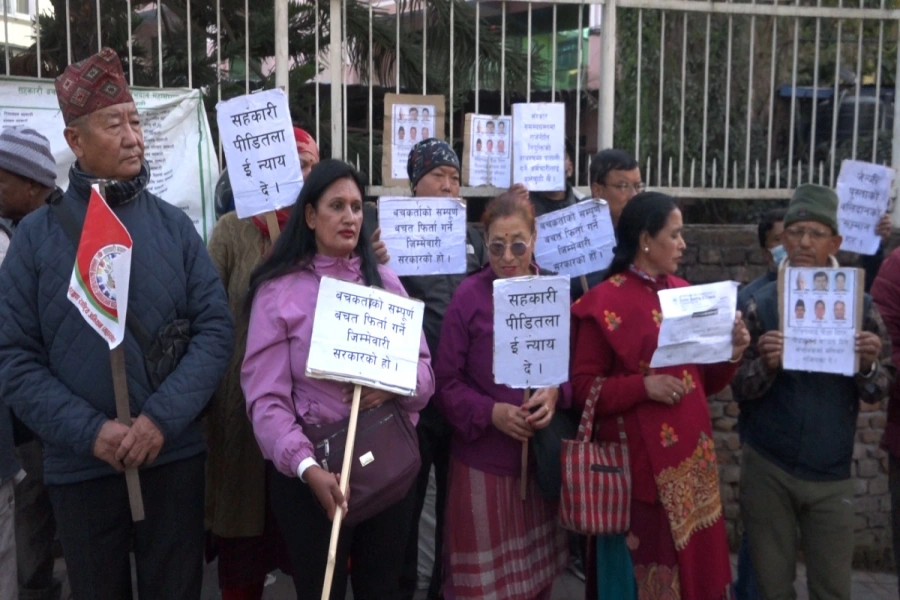
KATHMANDU, April 15: A steady stream of complaints is pouring into the Office of the Provincial Cooperatives Registrar (OPCR) in Bagmati Province, with victims of troubled cooperatives demanding the return of their savings—on average, more than 100 complaints every day.
The surge in complaints comes in the wake of a commitment made by the ruling Rastriya Swatantra Party (RSP), which had pledged in its manifesto to “ensure the safety of ordinary citizens’ hard-earned money and return deposits of small savers within 100 days.”
Following this promise, pressure has mounted on authorities, and complaints against cooperatives have sharply increased. So far, grievances have been lodged against 410 cooperatives under the jurisdiction of the Bagmati Province Government.
According to officials at the OPCR, the majority of complaints are directly linked to demands for a refund of deposits.
Registrar Pradipraj Paudel said the office is currently receiving more than 100 complaints daily, most of them related to the return of savings.
Desperate search for missing girls as nearly 80 dead in Texas f...

In addition, complaints are also being filed over account settlements and issues related to capitalized interest. OPCR officials said many depositors have alleged that cooperative operators charged interest rates higher than the prescribed benchmark.
The OPCR has stated that all registered complaints are being addressed promptly. Last week, Minister for Cooperatives and Poverty Alleviation of Bagmati Province, Binu Raiamajhi Paudel, inspected the OPCR office in Sanepa, Lalitpur, to review its functioning. During the visit, she directed officials to ensure swift action on complaints related to savings refunds and to strictly follow legal procedures to resolve depositors’ problems.
“Take the complaints from depositors seriously. Assist police investigations where necessary. Freeze the assets of cooperative operators where required and return the savings,” she said.
According to the OPCR, once complaints are filed, officials first conduct preliminary checks and then summon cooperative operators for discussions. The process of returning deposits is initiated only after this stage.
So far, more than 300 cooperative operators have been summoned for discussions, and tripartite meetings involving 51 cooperatives have already been completed.
There are currently 3,230 cooperatives under the Bagmati Province. Of these, five have been declared problematic: Civil, Namo Buddha, Lali Gurans, Sumeru, and Darshan cooperatives.
For such problematic institutions, the provincial government has set up a separate office in Anamnagar, Kathmandu, to facilitate the return of savings.
After the formation of the Indra Baniya-led provincial government, an office was established in the Kathmandu Valley on January 6, 2025, following a decision by Minister Paudel, to speed up solutions to cooperative-related problems by bringing all stakeholders together.
With more than 76 percent of cooperatives in Bagmati Province located within the Kathmandu Valley—Kathmandu, Lalitpur, and Bhaktapur—the office was set up there, according to the Ministry of Cooperatives and Poverty Alleviation. Officials said the absence of a dedicated regulatory office in the Valley had previously made monitoring and supervision difficult.
In the last fiscal year 2025/26, only 1,261 cooperatives—about 39 percent—submitted reports after holding their general assemblies. However, after the establishment of the OPCR office in the Valley, the number of cooperatives updating their records has increased significantly.
So far, 1,200 cooperatives have submitted their reports, and officials estimate the number will rise further in the coming months.
According to them, the establishment of the office has also made the process of receiving complaints and facilitating refunds more effective.
Under the law, cooperatives operating across multiple local levels fall under the jurisdiction of the provincial government. As per the Provincial Cooperative Act 2019 and Provincial Cooperative Regulations 2020, the OPCR is responsible for monitoring and regulating cooperatives in the province.