

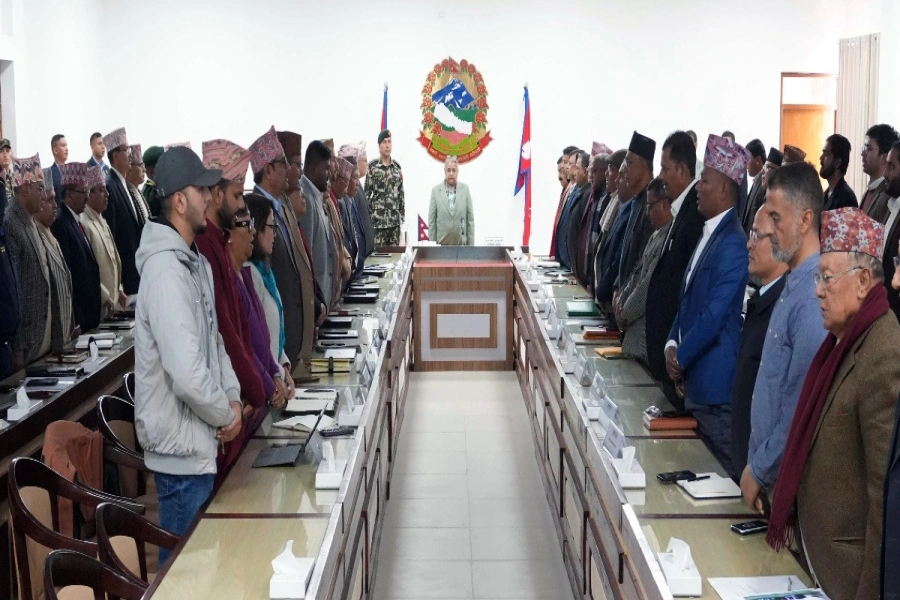
KATHMANDU, Dec 23: Even as the government presses ahead with dialogue with political parties to hold elections on March 5, major parties, including the Nepali Congress (NC) and the CPN-UML, are simultaneously pushing to revive the House of Representatives (HoR), deepening political uncertainty.
While talks on elections were underway on Monday afternoon, leaders from the NC, UML, and Madhesh-based parties were at the Supreme Court (SC), submitting lawmakers’ signatures to strengthen the case for HoR reinstatement. The parallel moves—one toward elections and the other toward reinstatement—have left the government in a visible dilemma.
Along with the NC and UML, lawmakers from the Janata Samajbadi Party (JSP) and the Janamat Party have also filed signatures at the SC against the dissolution of the HoR. As senior leaders engaged the government in talks, party chief whips were simultaneously delivering signatures to the court. NC Chief Whip Shyam Ghimire said additional signatures were submitted on Monday.
“We have submitted signatures of 65 lawmakers from the Nepali Congress. Signatures of three lawmakers—one each from the Janamat Party, JSP, and an independent—have also been submitted,” Ghimire said. Janamat Party lawmaker Goma Labh Sapkota and JSP lawmaker Hasina Khan have signed in favor of reinstatement, along with independent lawmaker Yogendra Mandal.
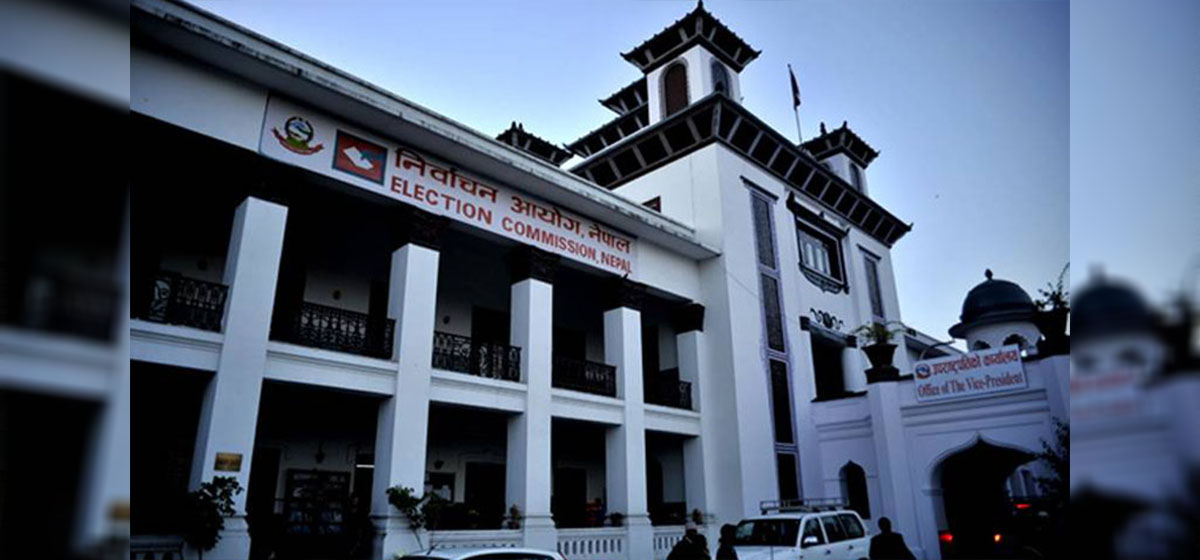
Election Commission issues 17-point election directive
The UML had earlier submitted a separate petition with signatures of all its lawmakers, reportedly 75 in total. With 143 lawmakers’ signatures now lodged at the SC against the dissolution, uncertainty has gripped the government. “On one hand, the government is preparing for elections; on the other, parties are knocking on the Supreme Court’s door for HoR reinstatement,” a government minister said, adding that the situation has begun to affect governance. The HoR has 275 members.
At least 138 lawmakers are required to form a government. With the NC, UML, JSP, and Janamat Party submitting signatures to demonstrate majority strength, the government’s dialogue with political parties on Monday failed to gain depth. During the talks, the NC urged Prime Minister Sushila Karki to immediately consult top leaders of major parties to ensure elections are held on schedule.
NC Deputy General Secretary Mahendra Yadav made the remarks at an all-party meeting on elections convened by the prime minister at Singha Durbar. He said elections cannot be conducted by creating hostility toward political parties and warned against delays in building a conducive political environment.
UML Secretary Mahesh Basnet, also present at the meeting, objected to the government’s ordinance, saying it sought to determine the order of election symbols through a lottery system. He argued that elections could not be held under the current circumstances.
“The government is repeatedly issuing ordinances that go against the democratic spirit,” Basnet said. “From what I have heard, the ordinance includes provisions to rank election symbols through a lottery. The government has no authority to amend laws that determine this based on past election results.”
Referring to the House of Representatives Member Election (First Amendment) Ordinance issued on December 19, Basnet said elections cannot be held by sidelining established political parties. “Your mandate is to conduct elections. Until the Supreme Court delivers its verdict or a political understanding is reached, build consensus among parties,” he said. “Elections cannot happen by excluding old parties.”
Yadav also raised objections to the ordinance, saying the NC expects the government to ensure free and fair elections without political vendetta. “Political parties are the backbone of democracy,” he said, urging the government to consult party leadership before introducing new laws.
However, Nepali Communist Party (NCP) leader Barshaman Pun ruled out any retreat from elections, warning that the party would not support any move beyond the six-month constitutional provision. “If elections are not held on time, the reinstatement of the HoR will be decided from the streets,” he said.
Prime Minister Karki, meanwhile, urged political parties to cooperate in holding elections. She said the government has been facing criticism from all sides—from Gen Z to political parties—and is bearing the fallout of past mistakes, including incidents on September 8 and 9.
“The ultimate sovereigns of this country are the people,” Prime Minister Karki said. “Political parties exist to serve them. Frustration over power-sharing should not be directed at the public. If people seek change, political parties must also reform themselves.”


-1200x560-1783083574.webp)








