KATHMANDU, Jan 27: With domestic rice production failing to keep pace with demand and imports continuing to rise, the government has moved to expand Chaite (spring) paddy cultivation in a bid to achieve self-sufficiency. The Ministry of Agriculture and Livestock Development (MoALD) has announced plans to roll out a Chaite rice promotion program across 22 districts of Madhesh Province.
As part of the initiative, the MoALD has allocated Rs 330 million for building irrigation infrastructure, a key requirement for Chaite rice farming. Officials estimate that the program could add as much as 1.2 million metric tons to national rice output.
The government has placed Chaite rice expansion at the center of its strategy to boost overall rice production. However, officials acknowledge that the push faces familiar challenges, including inadequate irrigation, erratic weather, and rising input costs for farmers. Since winter and spring irrigation is essential for Chaite rice, weak infrastructure in many areas has already affected production. In several locations, delayed water supply has led to late transplantation and lower yields.
Chaite rice is primarily cultivated in irrigated districts of the Terai–Madhesh and Inner Terai. These include Jhapa, Morang, and Sunsari in Koshi Province; Saptari, Siraha, Dhanusha, Mahottari, Sarlahi, Rautahat, Bara, and Parsa in Madhesh Province; Chitwan and parts of Makwanpur in Bagmati Province; Nawalparasi (East and West), Rupandehi, Kapilvastu, and Dang in Lumbini Province; and Kailali and Kanchanpur in Sudurpaschim Province.
'Chaite 5' paddy variety successful in Pokhara

Farmers in these districts mainly grow short-duration, high-yielding Chaite rice varieties such as Hardinath-1, Chaite-2, Chaite-4, Sabitri, and IR-64. According to MoALD, this variety of paddy is currently cultivated on around 70,000 to 80,000 hectares nationwide, with an average productivity of four to five metric tons per hectare. Under favorable weather conditions and with reliable irrigation, annual production could reach between 1 and 1.2 million metric tons.
Transplanted during Magh–Falgun (mid-January–mid-March) and harvested in Jestha–Asar (mid-May–mid-July), Chaite rice supports a double-cropping system, helping farmers increase income while reducing the country’s reliance on rice imports.
Despite access to improved seeds and fertilizers, farmers continue to struggle with low market prices. Experts say that expanding irrigation, ensuring incentive prices, introducing insurance schemes, and improving access to modern technology are crucial to making Chaite rice cultivation viable. Strengthening Chaite rice production, they argue, would significantly support the government’s food security and self-sufficiency goals.
Meanwhile, overall rice production has declined in the current fiscal year (FY), despite government claims of rising food grain output. Rice production from crops planted in Mangsir (mid-November–mid-December) of FY 2082/83 BS dropped by 4.20 percent compared to the previous year.
According to Ram Krishna Regmi, Senior Statistics Officer at MoALD, total rice production this FY stands at 5,705,126 metric tons—down by 250,350 metric tons, or 2,503,500 quintals, from last year. With the average price of medium rice fixed at Rs 3,628 per quintal, the decline translates into an estimated production loss of around Rs 9 billion.
Officials attribute the drop to a shrinking area under rice cultivation, delayed transplantation, and shortages of chemical fertilizers. Many farmers transplanted over-aged seedlings due to late planting and were unable to obtain sufficient fertilizer during the weeding stage.
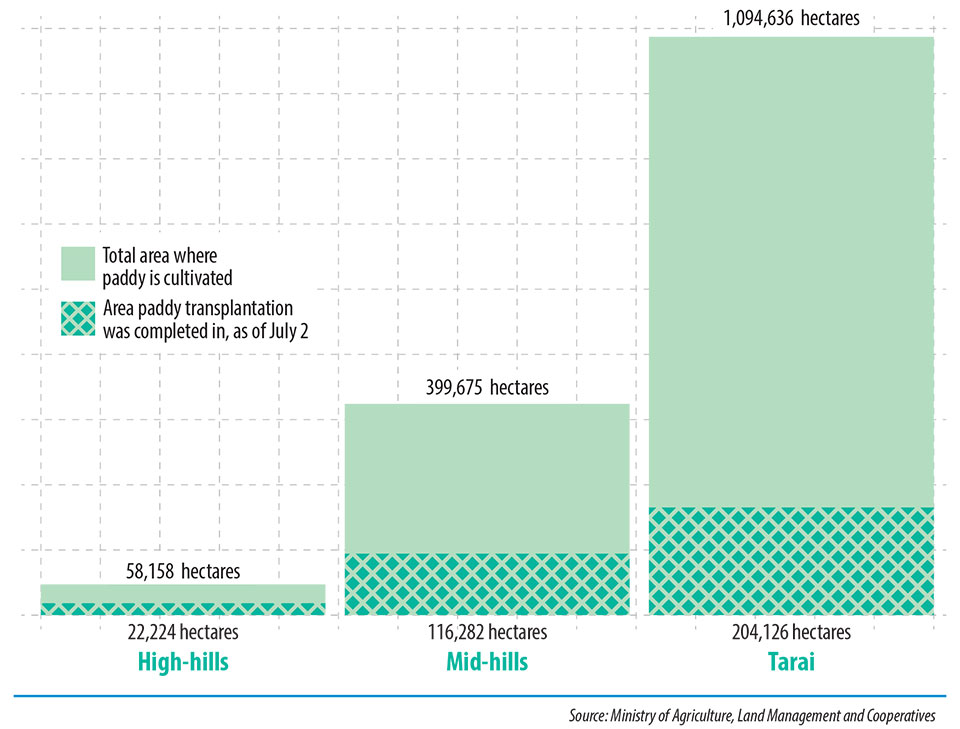
In FY 2081/82 BS, rice—both monsoon and Chaite—was cultivated on 1,420,636 hectares, yielding 5,955,476 metric tons. Nepal requires around 7 million metric tons of rice annually.
MoALD data show that rice productivity fell by 1.16 percent this year, declining from 4.19 metric tons per hectare last year to 4.14 metric tons per hectare. The area under rice cultivation also decreased by 3.8 percent, from 1,420,636 hectares to 1,376,872 hectares.
The MoALD cites migration from hill regions, youths’ growing attraction to foreign employment, and a shift toward fruit and cash crops as key reasons for the decline. In the Terai, urban expansion, industrial use of land, and infrastructure development have further reduced rice-growing areas.
Production in Madhesh Province was also hit by drought during the transplantation period. Although improved seeds and fertilizers were available in sufficient quantities, adverse weather conditions undermined productivity, the MoALD said.
Rice remains Nepal’s most important crop from a food security perspective. According to the National Statistics Office, agriculture contributed an estimated 25.16 percent to the country’s gross domestic product in the previous FY, with rice alone accounting for around 12 percent of total agricultural output.