

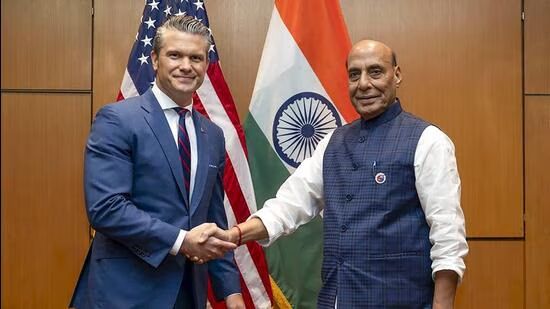
KUALA LUMPUR, Nov 1: The United States has signed a 10-year defense framework agreement with India, U.S. Defense Secretary Pete Hegseth said on Friday, Reuters reported.
The framework is considered a cornerstone for regional stability and deterrence, enhancing coordination, information sharing and technological cooperation between the two nations, Hegseth posted on X after a meeting with his Indian counterpart, Rajnath Singh, Reuters said.
“This advances our defense partnership, a cornerstone for regional stability and deterrence,” Hegseth wrote on X. “Our defense ties have never been stronger.”
Singh said the U.S.-India partnership is crucial for ensuring a free, open and rules-based Indo-Pacific region. “It is a signal of our growing strategic convergence and will herald a new decade of partnership,” he said on X.
U.S. Secretary of Defense Pete Hegseth announced a landmark defence deal aimed at strengthening security ties with India as he held talks with his Asian counterparts in Malaysia on Friday, according to Reuters
India, China agree to expand military ties after defense talks

Hegseth also met with India’s Defence Minister Rajnath Singh and they signed a 10-year defense framework aimed at expanding military and technological cooperation.
Washington has long sought to develop a deeper partnership with India, which is seen as a bulwark against China. India is a major defense partner of the U.S. and has, in recent years, embedded advanced American jets, helicopters, missiles and military gear into its armed forces, Reuters added.
“This advances our defense partnership, a cornerstone for regional stability and deterrence,” Hegseth wrote on X. “Our defense ties have never been stronger.”
Singh said the U.S.-India partnership is crucial for ensuring a free, open and rules-based Indo-Pacific region. “It is a signal of our growing strategic convergence and will herald a new decade of partnership,” he said on X.
The framework agreement comes amid renewed strains in bilateral ties after President Trump imposed a 50 percent import tariff on Indian goods in August and criticised New Delhi for continued purchase of discounted Russian oil. India is the second biggest buyer of Russian oil after China.
He told his Chinese counterpart during talks in Malaysia that the US would “stoutly defend” its interests in the Indo-Pacific.
“I highlighted the importance of maintaining a balance of power in the Indo-Pacific,” Hegseth wrote on social media platform X. “The United States does not seek conflict (but) it will continue to stoutly defend its interests and ensure it has the capabilities in the region to do so.”
China’s defense ministry issued a cautious response, emphasizing its longstanding positions. Dong Jun stressed the reunification of China and Taiwan is an “unstoppable historical trend” and urged the U.S. to be cautious in its words and actions on the Taiwan issue, the statement said.
“We hope the U.S. will translate its statements of not containing China and not seeking conflict into action, and work with China to inject positive energy into regional and global peace and security,” according to the statement.
Their meeting follows a 9 September video call between Hegseth and Dong and reflects ongoing efforts to manage tensions in the Indo-Pacific even as strategic differences, particularly over Taiwan and freedom of navigation, remain pronounced, Reuters said.
Hegseth also held talks with his Malaysian and Philippine counterparts.. He reaffirmed commitment to maritime security in the South China Sea and said the U.S. would “work relentlessly to reestablish deterrence in the South China Sea.”
Malaysia previously protested that the encroachment of Chinese vessels into its waters but usually prefers quiet diplomacy. That’s in contrast to the neighbouring Philippines, which has had major confrontations with China at sea in recent years. China claims virtually the entire South China Sea, overlapping claims made by countries including Malaysia, the Philippines, Vietnam and Taiwan, according to Reuters.
Asked to comment about U.S. President Trump’s plans to restart nuclear weapon testing for the first time in three decades, Malaysian defence minister Mohamed Khaled Nordin told a news conference later on Friday that ASEAN is a nuclear-weapon-free zone area and “we try to avoid anything that can bring great calamity to humankind.” He didn’t elaborate.







-1782782519.webp)


