

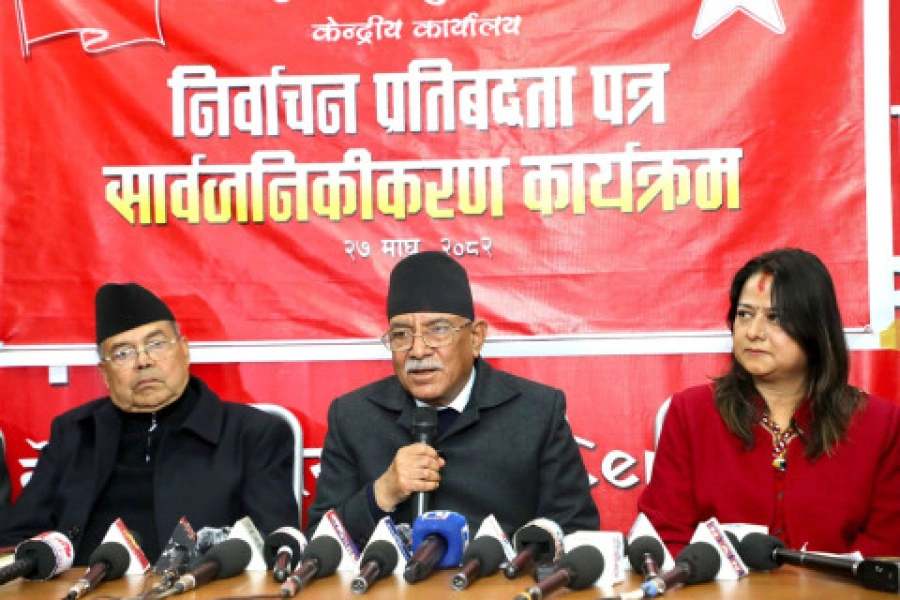
KATHMANDU, Feb 10: The Nepali Communist Party (NCP), has unveiled its manifesto for the March 5 House of Representatives (HoR) election.
NCP led by former CPN (Maoist Centre) leader Pushpa Kamal Dahal, under ‘star’ as election symbol, was formed through the merger of 22 communist and socialist factions.
This manifesto, like those of previous election manifestos, did not shy away from highlighting the party’s claim of bringing political transformations (federal republic) in the country.
It emphasizes political stability, anti-corruption measures, economic reforms, and social justice as top priorities. Echoing the voices of Gen Z protest the party has promised structural and administrative reforms to enhance governance.
Left Alliance manifesto promises growth and prosperity

Like plans to include a smaller cabinet, limiting lawmakers to legislative duties, and redistributing powers according to constitutional principles.
To strengthen governance and fight corruption, the party proposes establishing a “High-Level Asset Investigation Commission” to scrutinize the wealth of all public officeholders within a year. Assets of proven corrupt officials would be nationalized, and the Anti-Corruption Bureau and Vigilance Center would be merged into a powerful “Lokpal.” Government services are to be digitized, making them faceless and paperless, according to the manifesto.
NCP also set an ambitious target of achieving double-digit growth within five years. Reduce multidimensional poverty from 20.15 percent to 5 percent and create 500,000 jobs annually and support one lakh returning youth to become entrepreneurs.
Policies include attracting foreign investment into productive sectors, promoting domestic industries, reducing production costs, and minimizing trade deficits to boost economic self-reliance are prioritized.
Agriculture and land reform are central to the party’s agenda. The manifesto declares the next decade as the “Agriculture Investment Decade,” with a goal of achieving self-sufficiency in major food crops within two years. Farmers would receive pensions, pre-announced support prices, and guaranteed crop insurance. Landless Dalits and squatters would receive land ownership documents, aiming to eliminate landlessness and build an inclusive agrarian framework.
The party pledges to provide fully free health services as a fundamental right and to enroll all citizens in health insurance in the next six years. Treatment for non-communicable diseases would be available at the community level.
In education, the “One Municipality, One Smart School” concept will be implemented, universities will end political appointments, and appointments will be merit-based. Sports development will include doubling athletes’ prize money and constructing a 50,000-seat national stadium.
The manifesto promises generating 15,000 megawatts of electricity within five years, expanding the East-West Highway to four lanes, introducing a metro rail in Kathmandu, and completing Nijgadh International Airport. Tourism policies focus on smart and eco-tourism, positioning Nepal as a hub for international weddings and hill stations.
The party pledges proportional representation for Dalits, women, indigenous groups, Muslims, and marginalized communities, and to run national campaigns against caste-based discrimination. Dalit development initiatives include free primary-to-secondary education, scholarships for technical training, preservation and modernization of traditional skills, and establishing an integrated Dalit Development Authority. The party also pledges to support inter-caste couples with interest-free loans, promote social equity, and implement inclusive policies to benefit marginalized communities.
Foreign policy aims to strengthen non-alignment and resolve territorial disputes in Kalapani, Lipulekh, and Limpiyadhura diplomatically.
The NCP positioned major political parties like the Nepali Congress and the CPN-UML as conservative parties and new parties as populist parties without clear ideology.





