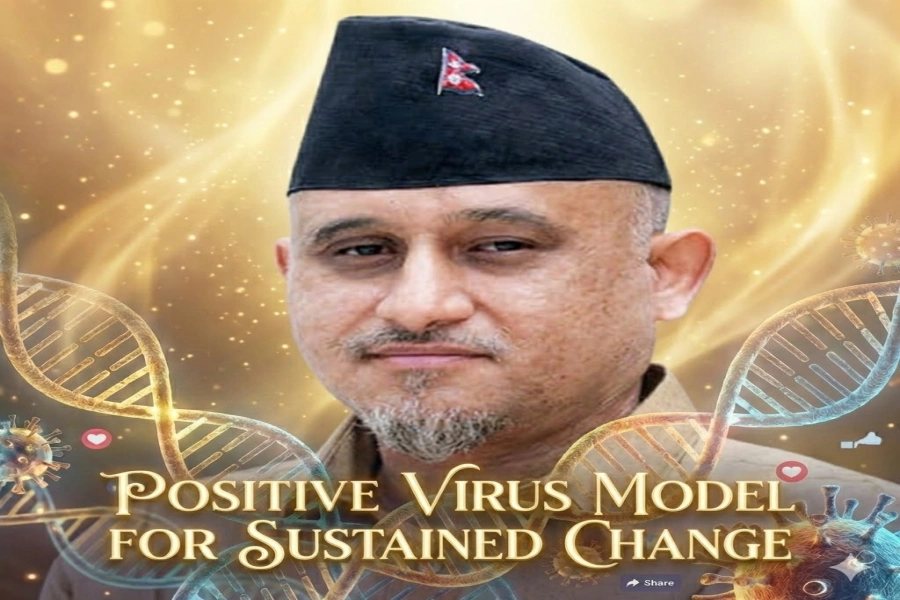
For decades, the story of Nepali politics was written in the ink of cynicism. To the average citizen, the “system” appeared as a monolithic beast—corrupt, jargon-heavy, and resistant to change. As a policy drafter, I used to submit policy documents to Ujwal Thapa for review. His primary concern was often semantics. He insisted that we must correct the grammar of politics itself—making it readable and understandable even to a seventh-grade student. He did not merely enter the political arena; he sought to rewire its very architecture. From the use of postmodern linguistics to redesigning campaign models, his weapon of choice was not a revolutionary manifesto but a philosophical formula: the “Positive Virus.”
As we navigate an era of digital noise and performative activism, the late Ujwal Thapa’s concept of change demands deeper interpretation. The convener of the Bibeksheel Nepali Party, Thapa never intended the “Positive Virus” as a mere figure of speech. It was a strategy for systemic evolution. He foresaw that a corrupt system could not be fixed simply by replacing one leader with another. What he envisioned was a remodelling of the collective DNA of society. In Thapa’s framework, the “Positive Virus” serves three roles: first, it deconstructs by breaking the apathy of “nothing will change”; second, it mutates by reintroducing empathy and integrity into the civic space; and finally, it co-creates a self-sustaining ecosystem of conscientious citizens.
Thapa understood that while Nepal produced “excellent individuals,” it often failed as a “collective society.” The Positive Virus was his answer to unleashing individual creative potential as a contagion capable of triggering nationwide transformation. His careful balance between virality and vitality was thoughtfully reflected in his campaign models. Although a master of the digital era, Thapa loathed cheap popularity. He pioneered a new political language—free from bigotry and heavy jargon—that had defined earlier generations. Through subtle and communicative narratives on social media, he reached directly to what he called “honest hearts.”
Positive PCR results in patients recovered from COVID-19 may no...

Yet, Thapa also issued a clear warning to agents of change: virality must be balanced with vitality. In an age of TikTok politics, his insistence on substance over optics feels more relevant than ever. He believed that change must be experiential, not merely visual. For him, leadership meant promising less and delivering more, ensuring that movements grew from character rather than clicks.
Perhaps Thapa’s most significant contribution was his rejection of the “strongman” archetype. He denounced boastful self-promotion and instead championed cooperative leadership. A “leader of leaders,” he often stayed in the background to groom the next generation. He did not just speak of inclusion; he practised it by actively nurturing the potential of women and youth. As a mentor, he offered both sustained encouragement and the necessary “bitter pill” of critical feedback. He believed in “doers” rather than “preachers,” recognising that true leadership lies in crafting and nurturing ideas that outlive the individual.
Ujwal Thapa’s death marked a physical loss, but his “Positive Virus” was designed to be regenerative. His approach was ecosystemic—aimed at creating a society where change was not a one-time event but a compounding process. Today, as independent voices rise and young people demand accountability, we are witnessing the mutations he set in motion. Thapa taught us that changing Nepal requires more than a loud revolution; it needs a quiet, persistent, and positive contagion capable of sustaining reform.
The “Positive Virus” was never intended to be a static memorial. It was conceived as a living, evolving code for the future. As Nepal approaches the pivotal Election of 2082 (March 2026), the philosophical seeds Thapa planted appear to have found fertile ground. The Gen Z–led uprising of September 2025 represented the ultimate “mutation” event—a moment when the viral energy of a digitally connected generation bypassed traditional power structures to demand systemic reboot.
The September 2025 movement, which led to the resignation of the old guard and the historic appointment of an interim government under Sushila Karki, served as a real-time manifestation of Thapa’s Positive Virus. This was not a movement driven by traditional party banners but a leaderless, conscientious contagion fueled by demands for accountability and the restoration of digital freedoms. For the first time, the “virality” Thapa spoke of transitioned from online discourse into a tangible systemic force, dismantling entrenched structures within days. It demonstrated that when a society’s DNA is sufficiently “mutated” by a shared sense of purpose, even deeply rooted hierarchies can be compelled to evolve. The Gen Z movement did not merely protest; it revived the Bibeksheel spirit by prioritising the collective over the individual, organising through decentralised networks, and demanding experiential change in governance.
As Nepal stands on the brink of the 2082 polls, alternative politics is undergoing a critical phase of ecosystemic integration. The recent merger among alternative forces represents a strategic effort to transform fragmented activism into a unified electoral force. In doing so, these groups are attempting to resolve the very dilemma that troubled Thapa: how to make excellent individuals succeed collectively.
This “coming together” marks the regenerative phase of the virus. Dissent from the sidelines is no longer enough. The rise of alternative practitioners—from seasoned people’s representatives and grassroots activists to post–Gen Z technocrats—signals a shift toward co-created change agency. Moving beyond mere “optical” unity, they are seeking shared vitality. By consolidating under the “Bell” election symbol, they aim to offer voters more than a protest option in 2082: a blueprint for a prosperous and modern Nepal.
Yet, the path to 2082 is fraught with the very risks Thapa cautioned against—virality without substance. With more than 100 parties registering for the upcoming election, the Positive Virus faces its greatest test: remaining genuinely positive. The temptation to revert to boastful rhetoric and jargon-heavy narratives remains strong. The true success of the 2082 movement will not be measured solely by seats won, but by whether these new actors uphold the empathy and accountability Thapa championed. The post–Gen Z voter is not searching for a new master, but for cooperative leadership that delivers lived change. To truly remodel the system’s DNA, this emerging coalition must remain a contagion of hope and integrity—ensuring that the mutation sparked in 2025 matures into sustained and compounding national evolution. The goal was never merely a winning party, but a prosperous nation of conscientious citizens co-creating their future. The virus has been released, and the system has begun to evolve.