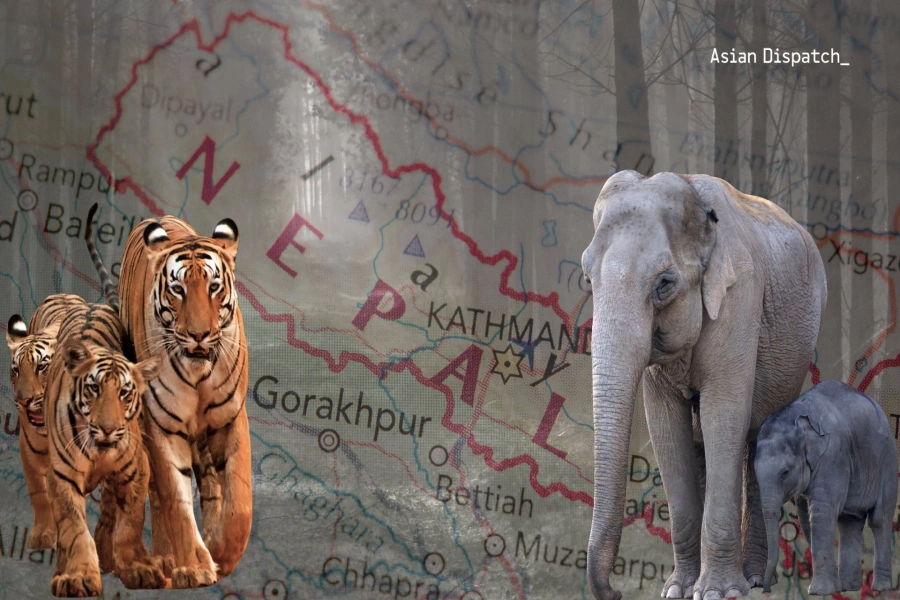
Hansraj stands at the edge of his land near Haripur Forest Range in Pilibhit, a city in the northern Indian state of Uttar Pradesh. It’s the break of dawn. The sugarcane in his farm stands tall and wet from the October morning mist. He carries a torchlight in one hand and a bamboo stick in the other. He is on the lookout for a tiger he had seen twice before.
The first was at dusk, a month ago. The second was two weeks after the first spotting when he was on his tractor one afternoon. The tiger was on the periphery of the land, gazing at him.
“Now I want to know where it is all the time. I sleep lightly at night. Every time the leaves rustle or a dog barks, I get up. I have stopped my children from playing near the fields, even during the day,” he says.
Hansraj, who has lived in this village on the forest’s edge for 44 years, is frightened, but he is not surprised. The weather is not what it used to be. Winters are shorter. It rains in bursts. His yield is dropping. “Everything has changed,” he says, adding, “Why won’t the tiger?”
One hears similar stories across the Terai in Uttar Pradesh.
In Chandan Chouki, a village near Dudhwa National Park, women working in the fields talk loudly to stay safe.
In Puranpur, locals have seen tigers using field bunds, embankments made along the farmland, and canal tracks for movement.
Meanwhile, in Nepal, elephants have expanded their range from Koshi Tappu Wildlife Reserve into the community forests of Udayapur and Sindhuli.
The Elephant Corridors of India 2023 report also shows elephants regularly using corridors with extensive agricultural land linking Dudhwa National Park and Pilibhit reserve to Nepal.
These incidents aren’t random or rare anymore.
“In the past five to 10 years, tigers and elephants have been moving into new areas beyond their traditional ranges, including community forests and corridors outside protected areas. These movements are closely linked to climate factors such as floods, droughts, and shifting water and food availability. [These] changes reduce natural habitats and safe corridors, pushing wildlife towards human settlements,” Dr. Chiranjibi Pokharel, director, National Trust for Nature Conservation (NTNC), Nepal, tells Asian Dispatch.
Changing Landscape
The Terai Arc Landscape (TAL), spanning Uttarakhand, Uttar Pradesh, smaller parts of Bihar in India, and the low lying hills of Nepal, is a mosaic of alluvial grasslands, sal, and riverine forests. It is also an extremely productive agricultural belt, with rice, wheat, and sugarcane fields everywhere.
“The land is fertile with high water tables. Historically, it supported luxuriant vegetation because it was always damp, moist, and slushy,” says Dr. Lakshminarayanan Natarajan, consultant, Elephant Cell, Wildlife Institute of India.
It made the Terai one of South Asia’s richest wildlife habitats and home to rhinos, elephants, tigers, swamp deer, hog deer, the Bengal florican, and many species of reptiles and amphibians.
But the conditions that once shaped this landscape are changing.
An analysis of warming trends between 1970-2016 shows rising temperatures across Nepal, including the Terai, where the rate of warming is 0.15°C per decade. The rate is the highest in the lower hills at 0.68°C per decade. Similar analysis (1951-2015) in India shows declining and uneven rainfall trends in most months across the Terai region of Uttar Pradesh.
These changes are reshaping grasslands and wetlands, the habitats that elephants and tigers depend on. Moreso, climate change doesn’t act alone; it intensifies existing pressures. For example: in Nepal’s Bardia National Park (BNP), stretches of the Geruwa-Karnali rivers, a lifeline for 125 tigers and 120 elephants, now runs nearly dry after the monsoon due to silt excavation upstream and declining water flows linked to climatic shifts.
Campaign to save wild elephants gathers momentum in eastern Nep...

“It is a mix of human-induced and climate-induced disaster,” says Dr. Ashok Kumar Ram, chief conservation officer, BNP.
A study published in March 2023 found correlation between rising temperatures and forest fires. This often results in degradation of animal habitat and also creates a fertile ground for invasive species such as Lantana camara to spread.
Found in over 40 percent of Indian forests, this species form dense thickets that suppress native grasses, shrubs, and herbs. This reduces the vegetation that deer and other prey depend on. As prey moves on, the habitat changes and the tigers follow them.
While for the elephants, Dr. Natarajan tells us, “Lantana is inedible. It reduces food availability for mega-herbivores. For elephants, that is equivalent to habitat loss. Elephants also need water daily. If habitats lack it, even for a short period, herds will move out.”
When Climate Change Collides with Animal Movement
The TAL has 13 protected areas: nine in India, including Corbett, Rajaji, Dudhwa, and Valmiki Tiger Reserves and four in Nepal, including Chitwan, Bardia, Shuklaphanta, and Parsa National Parks. These are connected through corridors that historically allowed animals to move freely.
For decades, the movement patterns were predictable. Most tigers stayed close to the forest and moved out only when dispersing. Elephants moved out of the Shivalik foothills during the dry months and returned when the monsoon arrived in India.
That predictability is fading.
According to the All India Tiger Estimation (2022), India has 3,682 tigers. But nearly 30 percent of them live outside protected areas, as per the Ministry of Environment, Forest & Climate Change (MoEFCC).
Dr. Rajesh Gopal, secretary general, Global Tiger Forum, says, “The India-Nepal Terai supports an estimated 1,174 tigers (as of 2022). They frequently move through key transboundary corridors such as Chitwan-Bardia-Dudhwa-Katarniaghat-Valmiki, Bardia-Banke-Katarniaghat, and Shuklaphanta-Pilibhit-Amangarh. These allow tigers to disperse into new home ranges, recolonise empty habitats, and revive small, struggling populations.”
But reducing forest cover, fragmentation, and infrastructure projects have narrowed links that allowed movement across the border through these corridors. In Uttar Pradesh’s Dudhwa and Pilibhit, forest teams now regularly record pugmarks along canal mud and livestock kills near villages, indicating tigers are using fringe habitats.
The habitat of elephants is reducing too.
A 2021 study shows a 21.5 percent decrease in elephant habitat in Nepal’s Chure Terai Madhesh Landscape between 1930 and 2020.
India faces similar challenges. In Uttarakhand, the Gola River corridor is severely impaired, leaving small herds of 50 to 80 elephants cut off from others. The Kilpura-Khatima corridor is highly fragmented too, broken by new highways. Trains in the Lalkuan-Haldwani stretch have caused elephant deaths in recent years.
As natural routes diminish and habitats become unreliable, elephants turn to farmland, especially sugarcane fields.
“Sugarcane is tall and sweet. It looks and smells like the wild grasses they fed on for centuries. The pull is obvious. Some herds develop habits and repeatedly raid farms,” says Dr. Natarajan.
The ‘Inevitable’ Conflict
As per Nepal’s official records, nearly 146 people died due to elephant attacks in Nepal between 2015 and 2025. A research paper published in 2017 notes elephants are responsible for more than 40 percent of the human-wildlife conflict, 70 percent of the wildlife-caused human casualties, and a 25 percent loss in crop production in the country.
Long-term data (2014-2025), accessed by Asian Dispatch from the Wildlife Trust of India (WTI), which works with the Uttar Pradesh Forest Department, shows: A sharp increase in human-big cat negative interactions over the past decade in the Pilibhit-Dudhwa-Katerniaghat landscape, with an average of three incidents of human injuries/deaths per month per year; Tigers account for 66 percent human deaths and 20 percent human injuries; and Livestock depredation is high, especially since there’s prevalence of feral cattle in the Indian Terai.
It affects daily life in the areas nearby.
In Mustafabad, schoolchildren take a longer route home because a tiger was once seen by the canal. “Women work in the fields in groups. And when we hear that elephants are in the area, houses take turns to hold vigils near the fields,” says Ramesh, a farmer who lives in Chandan Chouki.
None of this makes it to the official records.
Policy Matters
In 2010, Nepal and India signed a joint resolution on transboundary biodiversity conservation. It led to joint patrolling in border forests, faster intelligence sharing on poaching, and coordinated action during wildlife emergencies, including habitat restoration near key corridors in the TAL. But this resolution expired in 2015.
Despite India’s Union Cabinet approving an MoEFCC proposal to sign a new Memorandum of Understanding (MoU) with Nepal in August 2022 on biodiversity conservation, no movement has happened on that front.
“All the groundwork for the MoU has been completed. The only task now is to formalise it officially, which is expected soon,” informed Dr. Buddhi Sagar Poudel, Director General at the Department of National Parks and Wildlife Conservation (DNPWC), Nepal. He, however, didn't specify a date.
For now, cooperation relies heavily on personal networks. “Park authorities on both sides coordinate through regular trans-boundary meetings. Rangers and forest officials have direct communication channels to alert each other whenever there is any elephant, tiger or rhino movement,” says Akash Deep Badhawan, district forest officer, Barabanki.
The WTI has also initiated a protected area recovery project in Valmiki Tiger Reserve and adjoining areas in Bihar. It has a human-big cat conflict mitigation component, and they coordinate with the NTNC in Nepal.
But the absence of a formal MoU creates practical and procedural challenges. Cross-border visits and communication require high-level clearance. It can slow coordination in emergencies, when speed is essential. Differing legal frameworks mean the same incident gets different responses, a ranger in Dudhwa tells us.
When Communities Join Forces With Authorities
In Nepal, several community-led measures have been employed, including predator-proof corrals, electric/solar fencing, early warning systems and rapid response teams for conflict management.
“Community-managed corridors and coexistence programmes in Chitwan and Bardia have helped reduce conflict, because of local stewardship and timely response,” says Dr. Pokharel.
India’s response systems are expanding too. In March, Uttar Pradesh’s Principal Chief Conservator of Forests (Wildlife), Anuradha Vemuri, instructed the divisional chief conservators of forests to set up rapid response teams (RRTs) in all state divisions. The goal is to ensure immediate action and mitigate man-animal conflict.
The WTI, in collaboration with the Uttar Pradesh Forest Department, also launched Aapka Prahari, a public alert system in the villages of Sanda and Rampuriya in Pilibhit this year. Under the initiative, two e-rickshaws patrol during critical hours (early mornings and evenings) to alert residents and distribute information.
Community volunteers are also working on the ground, to sensitise communities and win trust. Uttar Pradesh’s Bagh Mitras (friends of the tiger) are trained by forest staff to help track big cats and prevent mob retaliation after attacks.
Gaj Mitras, their counterparts in elephant zones, help with night vigils, keeping herds away from crops using light and sound, and assisting families with compensation claims.
“If someone sees pugmarks, we verify and alert the forest staff on WhatsApp. People listen to us because we’re from the same village,” says Adnan Khan, a Bagh Mitra from Puranpur, near Pilibhit.
Forest rangers say these community links are crucial for conflict management.
“RRTs can reach within minutes only when local volunteers guide them. Where Bagh Mitras and Gaj Mitras are active, retaliation cases drop and responses stay calmer,” says Shahir Ahmad Khan, forest range officer, Haripur range.
This year, for instance, Pilibhit Tiger Reserve recorded its first man-tiger conflict-free sugarcane harvesting season, despite incidents of tigers straying into nearby fields. Manish Singh, its divisional forest officer, credited it to the 1,070 solar lights installed around 90 sensitive villages' peripheries and the Bagh Mitra programme.
At times, the community also comes together to take measures to mitigate conflict. In Bharatpur village, Pilibhit, residents voluntarily replaced sugarcane with paddy and wheat a decade ago. There has not been a single human fatality since. “Such voluntary social regulation has the potential for scaling up to neighbouring villages and even across the border,” says Abhishek Ghoshal, conflict mitigation head at the WTI.
Gaps still remain.
Compensation for human and livestock attacks is relatively quick. For crop damage, it can be slow, often delayed by paperwork and verification. There is also a problem of perception. “Human injury or death due to accidental attacks by big cats can lead to protests or agitation. Under public or political pressure, authorities are sometimes compelled to take people-centric decisions that may not align with long-term conservation priorities,” says Ghoshal.
The Way Forward
The coming decades will decide the future for the Terai region. Climate change will play a major role in deciding how wildlife moves, where humans farm, and how both share space. A 2025 study already shows that new areas outside protected habitats in Nepal could emerge as more suitable tiger habitats in the next few decades. It could push the big cat closer to people, as climate change influences habitat.
To counter it, experts say that wildlife corridors will need no-build zones and restoration. “These are crucial to maintain gene flow, prevent inbreeding and maintain effective population size,” says Dr. Gopal.
Experts also suggest building early warning monitoring systems and common compensation frameworks. Climate resilience will have to be built into wildlife planning, with a focus on waterhole restoration, invasive species control, and grassland revival that can withstand extreme weather. In some cases, humans will have to be shifted to give wildlife more space.
“Relocating Van Gujjar communities from inside Rajaji Tiger Reserve was a success. It reduced conflict and restored habitat,” says Dr. Natarajan.
In the wake of the climate challenge, maintaining and enhancing landscape connectivity in this region requires transboundary cooperation and coordination between Nepali and Indian authorities. “If successful, it will bring considerable benefits for the conservation of elephants and other wildlife,” says Dr. Poudel.
For now, Terai’s forests and fields are holding both people and animals in an uneasy balance. Hansraj knows it. “How long that balance holds will depend on how fast we adapt to the changes around us,” he says.
This story was produced by Asian Dispatch and originally published [https://www.asiandispatch.net/climate-change-pushing-tigers-elephants-closer-to-humans-in-terai-arc-landscape] on 3 December, 2025. It has been co-published by Nepal Republic Media Limited.


-1200x560-1774606010.webp)
-1200x560-1783685616.webp)