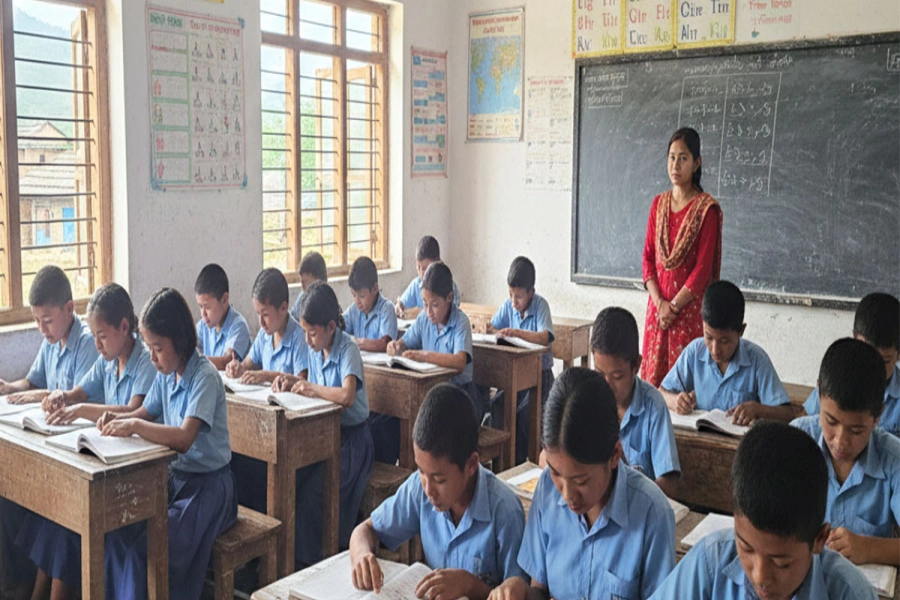
Nepal has finally aligned its school structure with the Constitution, more than a decade after the new federal charter came into force. By amending the Education Regulations, the government has formally replaced the old four-tier school education system with a two-tier model: Basic education from Grades 1 to 8 and Secondary Education from Grades 9 to 12. The long-delayed reform has removed the legal contradiction that allowed an outdated education framework to survive even after the Constitution had redefined school education. It creates a legal basis to overhaul teacher recruitment, promotions, transfers, curriculum planning and school administration. It also gives local governments a stronger role in managing schools and resources. Yet the reform arrives with unfinished business. Existing teacher service conditions remain unchanged, the proposed School Education Act is still pending, and the Teacher Service Commission remains without office bearers. Teachers' representatives have also raised concerns over transfers, staff deployment and the unclear division of responsibilities among the federal, provincial and local governments. Still, the shift deserves recognition because Nepal's previous school structure had long outlived its purpose. Dividing schools into primary, lower secondary, secondary and higher secondary created unnecessary administrative obstacles. Students moved through multiple stages that often had different management systems, teachers and policies. Grades 11 and 12 became part of school education years ago after the Higher Secondary Education Board was dissolved, yet they continued to operate, creating confusion and fragmented planning.
E-learning centers in Banepa community schools

Nepal should have made this transition years ago. The Constitution settled the issue in 2015, but outdated laws kept the old structure alive. Political disagreements together with the lack of a new education bill and the hesitation of various parties to adopt changes in the educational institutions have left the country with an education system at the crossroads of old and new trends. Not only did this lead to the waste of a precious period of time, but more importantly, they were able to avoid taking tough but necessary steps at the right time. Unfortunately, with Nepal, this has not happened and they are still trying not only to cope with this inconsistency themselves but also making up for the damage caused by years of confusion and contradiction. Students facing difficulty would get the assistance needed before it's too late rather than waiting until they end up caught in bureaucratic limbo. Also, the junior level of education will not necessarily miss out on this reform. Considering Grades 9 - 12 as a single, integrated phase would enable the schools to tailor the learning experiences better for the students wanting to pursue different tracks like university, technical or vocational studies, or just employment. So, the design of the course content can be done with greater unity. It would also be possible for the students to get guidance about their careers and subjects through different stages gradually rather than jumping from General to Higher Studies straight after Grade 10.
Meanwhile, if given proper guidance, teachers would be able to find themselves at the right spot about their professional and educational progression as well as their professional development.But none of this will happen automatically. A new structure alone cannot fix weak learning outcomes, teacher shortages or poor governance. The government must quickly pass the School Education Act, appoint a fully functioning Teacher Service Commission and clarify the responsibilities of all three levels of government. It must also address teachers' legitimate concerns instead of allowing reform to become another source of conflict. Nepal has finally corrected a mistake that lingered for more than a decade. The challenge now is to turn a legal reform into better classrooms, better teaching and better learning. If implemented with commitment, the two-tier school system can provide the strong educational foundation that every child needs before stepping into higher education.