During the COVID days, I began to recognize a quiet resilience in a ball of yarn. Watching Samantha Moore’s film ‘Visible Mending’ and reading the accompanying article, “Knitting Helps Us Embrace Life’s Messy Imperfections,” which reflects on life’s messy imperfections, confirmed this for me and brought back memories of the years I spent with needles in my hands.
I never set out to use crochet as a deliberate form of healing; it was simply a quiet, rhythmic anchor during times when everything else was falling apart. Only now, after watching the film I recognize those stitches for what they really were: a means to sanity, a lifeline. They reminded me of how knitting and crocheting had quietly carried me through my own challenges. At the time, I didn’t think of them as coping strategies, but for me, they worked. The article deeply resonated with me.
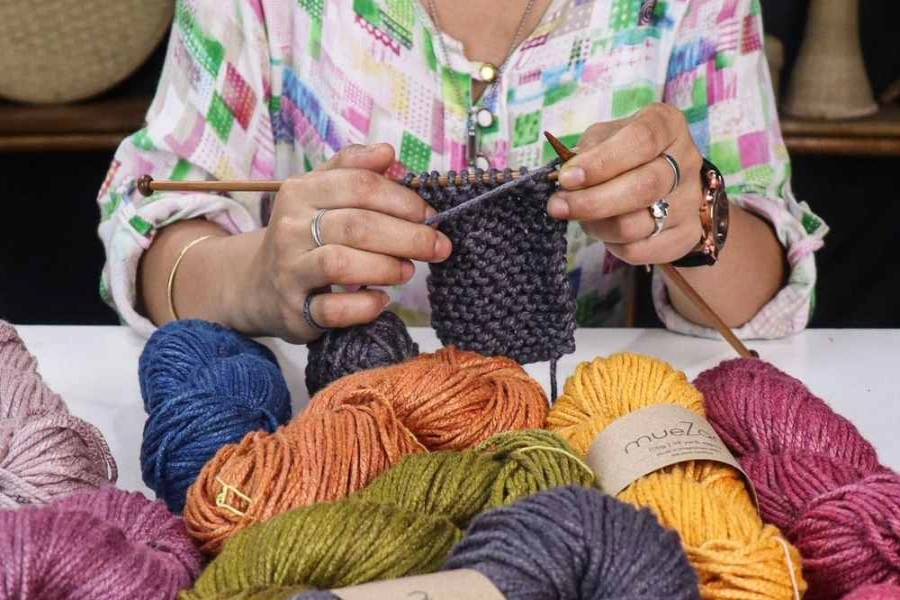
I have always been fascinated by both knitting and crochet, but I was more comfortable with crochet. While knitting was another story altogether. Over time, what began as a simple hobby became an essential part of my mental well-being. Whenever I felt overwhelmed by disappointment or academic failure, my hands automatically found refuge in crocheting. Later, my research confirmed my coping mechanism as a reality, when I found evidence that suggested the rhythmic, repetitive motions had distracted me from my misery and soothed my nervous system. When my mind was too exhausted to think or calm down, my hands stayed busy drawing my attention while carefully working out the pattern of a doily.
I know it may seem unbelievable that something as simple as crocheting or knitting can ease pain and restore a sense of peace. But these crafts truly work, even though they are often dismissed as mere hobbies, passed down from mother to daughter. I suppose they were really coping mechanisms handed down through generations, without anyone fully realizing they were giving their daughters tools to survive the hardships they themselves had faced. In my case, though, it was Baba who taught me to knit.
My first experience of coping with difficulties was when I was eight years old, living in Kolkata with Baba, attending a new school, and going through a very difficult time. I remember coming from school one day, asking Baba how to make a ‘tea cozy’. I was assigned to knit a teapot cover, a ‘tea cozy’, as a school assignment. Confused and intimidated by the task, I asked Baba for help. He taught me how to cast on, knit, and purl. I still have that Mastercraft with me, and every time I see it, it reminds me of the difficult times I had back then and how I coped.
World Bamboo Day: Rethinking Bamboo for Nepal

At that age, I didn’t understand the psychology behind it; I only knew it was a school assignment I had to finish. Only much later did I realize that Baba had given me a tool for resilience; something I could return to whenever I needed it.
As I grew older, I noticed Ama doing the same. She had spent 18 years in exile, moving between Nepal, Kolkata, and Varanasi. During those years, we lived with a constant lack of control and the harsh reality of being refugees in foreign lands. Looking back, I think she was likely healing from her own trauma through her craft. Whether she was knitting a sweater or crocheting lace, she was quietly distracting herself from everything beyond her control. Unknowingly, every row had helped her hold on to her sanity.
Back then, I didn’t understand the therapeutic nature of knitting or crocheting. As a child, I saw only the steady movement of hands and the finished pieces that emerged. Everyone thought she had a gift for creating a sweater for Baba, my sister, or me. No one knew better. I myself didn’t see anything special beyond making something for someone. Now, when I look back, I see how I, too, always returned to crocheting whenever I felt stressed or when life seemed out of control. After Ama passed away, I put crocheting out of my mind and eventually forgot about it. I, too, dismissed it just as a hobby.
Then came the spring of 2015, and with it, the earthquake. Baba’s old house collapsed; it was destroyed. Later, as we salvaged what we could, I found Ama’s stash of yarn, her knitting needles, and her crochet hooks. I didn’t know then that these hooks and needles would one day become my lifeline in another disaster.
Five years later, in 2020, disaster returned in the form of the COVID-19 pandemic. I found myself overwhelmed by a fear I couldn’t manage. My father was in his nineties, my brother was in his eighties, and most of my relatives were elderly. News reports repeated that people like them were at the highest risk. Life felt terribly uncertain, and I felt a need for control.
What better way to cope than to create something when everything else was breaking down? I remembered the yarn and hooks I had rescued after the earthquake. I thought of Ama using them when she was sick; she often had no clear idea what she was making, yet she kept knitting. When asked, she would say she was knitting a sweater for either Baba or Subas Jwain Sab. She had forgotten the patterns, but her hands remembered the motions learned years ago in Kolkata.
I picked up a hook and slowly began a doily. Almost immediately, I felt a small but real sense of control. I couldn’t control a virus or a lockdown, but I could control my crocheting. When the world was unpredictable, the next stitch and the next pattern were certain. I had power over what I was creating, and I could see a clear end product in sight.
After reading Samantha Moore’s article, I did some research of my own. Science suggests that using both hands in a coordinated way helps the brain process trauma. I also learned that traditional “talk therapy,” a top-down approach, can be difficult when the brain is stuck in survival mode. In contrast, repetitive, rhythmic sensory tasks—like the movement of needles or the looping of yarn—offer a bottom-up path to healing. The process calms the nervous system through the body first, and then the mind follows. Studies indicate that the rhythmic nature of these crafts stimulates the nerves, helping the body shift from fight or flight into rest and digest.
I experienced this firsthand during the lockdown, when I started crocheting again. Creating something became a need when nothing else helped. I needed to step away from constantly worrying about the future. Crocheting relaxed me and lifted my mood. It gave me hope. In a time when everything felt unpredictable, the certainty of a crochet project’s outcome was a profound comfort.
During that period, local stores were allowed to open for only one hour a day. I would rush to the shop to find whatever supplies I could. I remember the shopkeeper asking, “What are you using all this yarn for?” I told her the truth: I was making hats and scarves for children and adults who needed them.
Not everyone understood. Some laughed, wondering why I was “wasting my time” on a hobby when everything was serious. They didn’t realize I wasn’t ignoring the trauma; I was processing it. My hands were busy, and my heart was quiet.
As restrictions eased, I began driving to the Woolhouse to buy yarn. The salesgirls became friends. Sometimes they even pressed extra skeins into my hands, saying, “Make socks.” I used that yarn to make hats, mufflers, and socks. I gave them to children, adults, relatives, and friends, who then passed them on to people in greater need. In a time of darkness, I wanted to bring a smile to someone’s face. I had found my peace and, in the process, I was able to share it with others.
Finally, it’s time to recognize that crafts, so often dismissed as mere pastimes, are powerful tools that help us heal as we create. It might seem odd, but I’ve learned that even when life is complicated, the patience and persistence involved in making something brings peace. It’s simple. Believe it or not, but simply picking up a needle or hook, starting to knit, and watching something warm and useful take shape can be deeply comforting. Similarly, we can learn to handle difficult situation of our lives, when nothing seems to work and when nothing is under our control. This sense of control, the quiet productivity, and the sharing of what we’ve made help us maintain our sanity, help find our way back to hope and a new kind of normal.
The author can be reached at pokharelusha@gmail.com. Her writings can be accessed at https://myrepublica.nagariknetwork.com/author/1042/usha-pokharel.