

KATHMANDU, Feb 15: Framing itself as a force for systemic reset, the Rastriya Prajatantra Party (RPP) on Saturday unveiled a six-point election manifesto ahead of the March 5 House of Representatives (HoR) polls, pledging sweeping changes to Nepal’s governance model and constitutional structure.
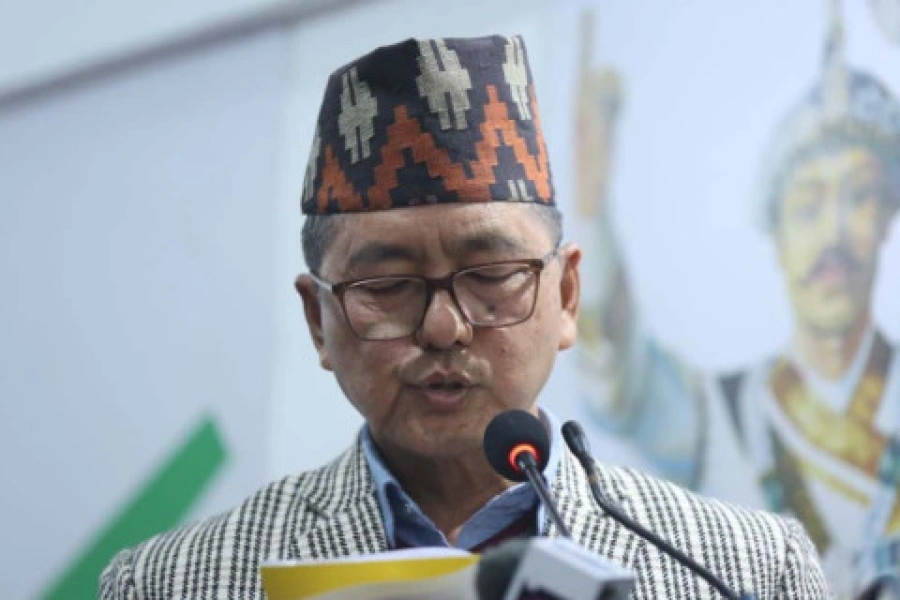
At a programme held at the party’s central office in Kathmandu, Chairperson Rajendra Lingden read out what the party termed its “Commitment Document,” outlining an alternative political vision that challenges the federal republican order established after 2008.
The RPP’s long-term vision centres on building what it describes as a strong, prosperous and advanced Nepal. The party has laid out ambitious national goals that include capital formation, sustainable development, free access to education and healthcare, social security, social justice, equitable prosperity, youth-focused productive growth and broad-based employment generation.
RPP to prioritize Hindu nation and King in election manifesto

Looking ahead, the party has set a target of elevating Nepal to a middle-income country by 2030. To reach that milestone, it has pledged to pursue sustained economic growth, improve the quality of health and education services, reduce poverty, expand technology use, develop strategic infrastructure, promote sustainable urbanisation, enhance productivity, strengthen public service delivery, maximise and conserve natural resources, and ensure long-term social security.
On matters of national interest, the RPP has vowed to formulate a core national security policy aimed at safeguarding independence, territorial integrity, sovereignty and national unity, while also protecting and promoting Nepal’s natural, religious and cultural heritage.
A central plank of the manifesto is the party’s renewed commitment to reinstating Nepal as a Vedic Sanatan Dharma–oriented Hindu state. At the same time, it has pledged to guarantee equal freedom and equality for all religions. The manifesto explicitly commits to criminalising caste-based discrimination, untouchability and any form of bias based on religion. It further promises to respect, protect and promote all religious communities practised in Nepal and to ensure citizens’ rights to worship and observe their respective faiths, cultures and traditions without interference.
Institutionally, the RPP has proposed a fundamental restructuring of the state. It advocates restoring a constitutional monarchy in what it describes as a guardian role, alongside comprehensive reforms to what it calls the current costly and unstable electoral system. The party also seeks to abolish the provincial structure introduced under federalism and replace it with a two-tier system comprising a central government and empowered local governments. In addition, it has proposed non-party-based local governments as part of its broader effort to reshape the governance framework.
With these proposals, the RPP has positioned itself as a pro-monarchy and anti-federal alternative, seeking to capitalise on growing public debate over governance costs, political instability and identity politics as the country heads into a crucial electoral contest.

-1200x560-1781083488.webp)








