

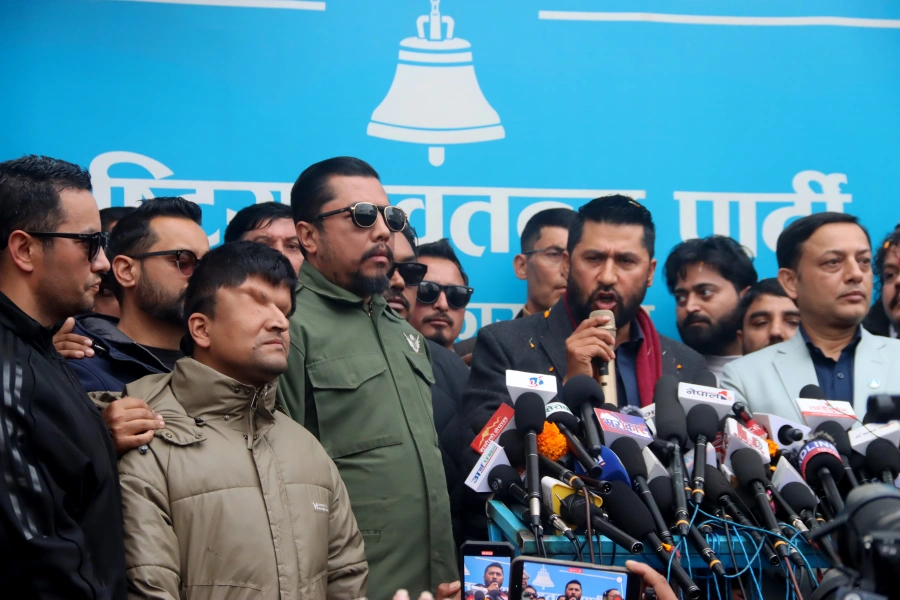
Nepal’s political landscape is evolving rapidly as the country approaches the House of Representatives (HoR) elections scheduled for March 5, 2026. Political activity has intensified, marked by hurried realignments, tactical mergers, and the proliferation of new parties. The Communist Party of Nepal (Maoist Centre) set the tone by unifying a dozen smaller outfits, while Tarai-based fringe parties—long synonymous with cycles of merger and split—have once again regrouped. Beneath this flurry of organizational engineering lies a deeper transformation: the growing allure of personality-driven, celebrity-style politics that promises disruption but risks impermanence.
The most striking feature of the current political moment is the proliferation of prime-ministerial aspirants. Nearly a dozen figures—drawn from both established parties and newly formed outfits—have declared themselves contenders for the country’s highest executive office. Each claims not only electoral viability but an inevitable ascent to power. This inflation of ambition reflects less political confidence than a troubling erosion of seriousness in Nepal’s democratic culture, where aspiration increasingly outpaces preparation, credibility, and accountability.
Among the more audacious claims is that of Kul Man Ghising, a former bureaucrat who recently resigned as Minister for Energy, Water Resources and Irrigation. While he continues to enjoy public visibility, much of his reputation rests on a carefully curated narrative. The widely celebrated end of load-shedding, for instance, came at a significant cost to the productive sector, as power was redirected from industries to households—relieving urban inconvenience while quietly undermining economic activity. This trade-off, rarely acknowledged in public discourse, raises legitimate questions about policy judgment and long-term vision.
Ghising’s confrontational posture, retaliatory mindset, and absence of a tested political base invite concern rather than admiration. Allegations regarding his proximity to external interests further complicate his claims, whether or not they are conclusively substantiated. What is unmistakable, however, is the confidence with which a relatively obscure former bureaucrat mired in corruption cases now lays claim to the premiership. Such overreach is symptomatic of a deeper malaise in Nepali politics, where celebrity, controversy, and noise increasingly substitute for legitimacy and experience.
The Perils of Food Insecurity in Jumla

This distortion should alarm both political leaders and voters alike. His brief merger into and split from the Rastriya Swatantra Party (RSP), a party led by a highly controversial figure, underscores the impossibility of his bid. It is therefore incumbent upon the electorate to look beyond surface-level narratives and scrutinize the record, temperament, and intent of those seeking power. Democracy is diminished when ambition is mistaken for ability.
Rabi Lamichhane, president of the RSP, exemplifies the fragility of celebrity-fuelled politics in Nepal. Catapulted to power on the populist slogan “No, Not Again,” he soon abandoned his anti-establishment posture and aligned himself with K.P. Sharma Oli and Pushpa Kamal Dahal—the same leaders he had promised to dislodge—to assume the office of Home Minister. This political surrender stripped him of the moral high ground he once claimed. Compounding the erosion of credibility are unresolved cases before the Supreme Court concerning dual citizenship and passports. A leader who rose to prominence by crusading against corruption now finds himself mired in controversies that mirror the very system he pledged to dismantle.
Lamichhane’s fall from grace culminated when he released himself from jail on September 9 on the strength of a mob producing a fake release letter and in a shocking indictment and imprisonment for misappropriating the hard-earned savings of ordinary citizens through multiple cooperatives nationwide. What began as a narrative of bold reform and public trust has been reduced to one of opportunism, betrayal, and reckless misuse of both power and public confidence—a stark reminder that charisma cannot substitute for integrity in politics.
Balendra Shah (Balen), who resigned as Mayor of Kathmandu Metropolitan City, represents another illustration of Nepal’s celebrity-driven politics. His role during the September 8-9, 2025, unrest has drawn serious scrutiny. In the name of Gen G protesters, infiltrators ransacked and set fire to historically and institutionally significant sites, including Singha Durbar and the Birendra International Convention Centre, home to the HoR, the Supreme Court, and the offices of the President and Prime Minister. The violence extended to other government establishments, media houses, business enterprises, and residences of senior political leaders.
In the immediate aftermath, Balen refused the prime ministerial post despite his decisive role in the collapse of the KP Sharma Oli-led coalition within 27 hours, instead proposed former Chief Justice Sushila Karki as prime minister. Yet he neither publicly consoled the families of the 19 protesters killed by police firing on September 8, 2025, nor visited those injured in the unrest. For many young protesters who had risked their lives over two turbulent days, this silence felt like abandonment. Once buoyed by uncritical trust from Gen G youths and politically inexperienced citizens, Balen’s image has since fractured, raising questions about leadership, accountability, and moral responsibility.
By resigning before completing his five-year mayoral tenure, Balen forced a costly by-election and demonstrated that personal ambition increasingly trumps public duty. Renu Dahal, mayor of Bharatpur Municipal Corporation and Harka Sampang, mayor of Dharan Sub-Metropolis, have followed a similar path, resigning to contest the prime ministerial race—signaling a worrying normalization of opportunism in Nepali politics. If stewardship of a city proves elusive, how can stewardship of a nation be assured?
Ukraine’s Volodymyr Zelensky’s ascent from a comedian to a president is often celebrated as a triumph of democratic openness. Yet it also illustrates how celebrity legitimacy can overwhelm political preparedness. Electoral popularity, amplified by performance skills and emotional resonance, propelled Zelensky into office despite his limited grounding in diplomacy, security affairs, and statecraft. The ballot rewarded familiarity and symbolism over experience, demonstrating how modern politics can privilege recognition above readiness.
Zelensky’s leadership style—honed in entertainment rather than governance—relied heavily on performance, moral clarity, and emotive appeal. These attributes proved powerful in mobilizing public sentiment, rallying national resolve, and commanding international sympathy once war erupted. However, politics at the highest level, particularly in geopolitically vulnerable states, demands more than moral conviction and narrative strength. It requires strategic restraint, calibrated diplomacy, and an acute reading of power asymmetries. In Ukraine’s case, the dominance of symbolism and moral absolutism arguably limited the space for pragmatic maneuver when geopolitical tensions reached a breaking point.
Ukraine’s devastation cannot—and should not—be attributed to one individual alone. Structural vulnerabilities, historical antagonisms, and external aggression played decisive roles. Yet leadership matters most at moments of crisis. Zelensky’s inexperience in navigating great-power politics may have narrowed diplomatic options at a critical juncture, leaving fewer off-ramps once escalation began. This is where the parallel with Nepal’s emerging celebrity politicians becomes instructive. Figures like Balendra Shah similarly derive authority from visibility, performance, and defiance rather than from institutional grounding or political apprenticeship. The concern is not about intent, but about capacity. In fragile states, leadership shaped more by spectacle than statecraft risks converting popularity into peril. Celebrity may win elections, but it rarely equips leaders to manage the unforgiving consequences of power.
It is high time for voters—particularly Gen Z and young citizens disillusioned with the failures of traditional political parties—to exercise greater political discernment. Those who aspire to good governance, a stable and principled political culture, and a prosperous Nepal must learn to distinguish between the fleeting allure of celebrity cults and the far more consequential realities of statecraft, including the deepening interference of external powers in Nepal’s internal affairs. The inability to separate the genuine from the spurious, performance from principle, will only accelerate Nepal’s political decay and compromise the future of coming generations. The cost of mistaking spectacle for statesmanship is simply too high. Let us not produce another Zelensky.


