

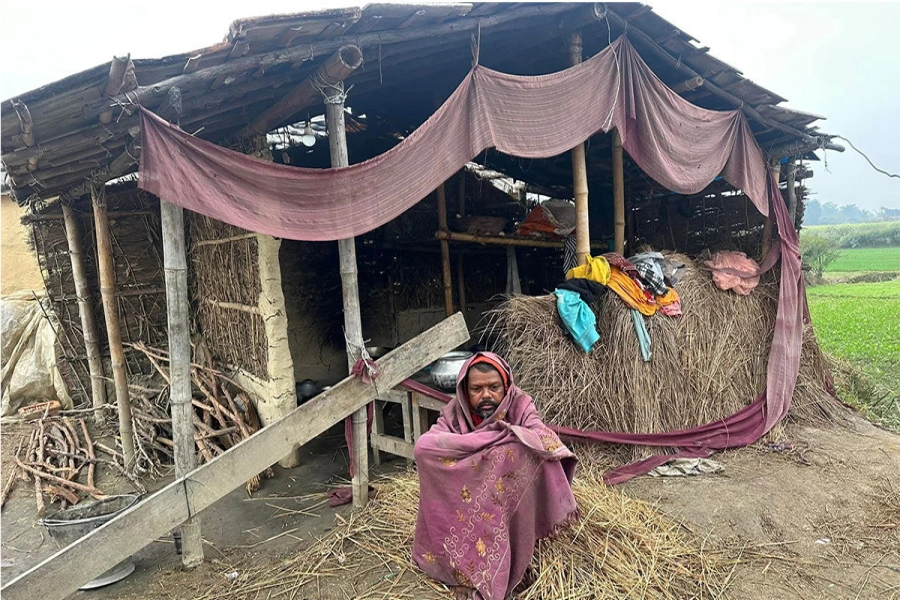
KATHMANDU, Jan 1: About 500 meters south along the East-West Highway lies Musahari Tole, Golbazar Municipality–8, Siraha. In a fragile bamboo shack, a heap of straw sits in one corner, while thin, worn-out clothes are scattered across the floor. A straw mat covers the cold ground, topped with patchy pieces of cloth used as bedding.
This is the home of Rambilas Sada, who lives here with his four children. A week-long cold wave has left the family shivering. When asked why he sits outside in the freezing wind, Rambilas replied, “It feels colder inside than outside. The floor, the straw, and even the bedding are all frozen.”
The shack is open on all sides, letting wind sweep through and chill everything inside. Nights are the hardest—they cannot sleep. Each evening, they face a cruel choice: burn their straw mat for warmth or spread it on the cold floor to sleep. Local authorities have provided neither firewood nor blankets to ease their suffering.
Love and rural life

“There is no one to see the struggles of the poor like us. We are surviving only by trusting in God. It feels as if this wind might take our lives,” Rambilas said.
He is not alone. All 20 Musahar households in the area endure the same hardships, relying on faith to survive. Near Mainawati Bridge in Golbazar Municipality–11, some 40 Musahar families live in equally fragile shacks.
Sumitra Sada, another resident, shields her home from the western wind with torn saris and cloth, working day and night. “This wind feels like it will take our lives,” she said. At night, straw mats get soaked from condensation, drenching clothes and bedding used for warmth. “We survive only by trusting in God. There is no one else to help us,” she added.
In Golbazar Municipality–10, Kunti Sada, 40, spends her days drying wet bedding in the sun and laying it out again at night. “When the government came, they promised the poor wouldn’t suffer in the cold. It was all false propaganda,” she said. “Even if they come, they do not provide warm homes or bedding.”
Similarly, in Tatreebari, Mirchaiya Municipality–7, Shobha Sada has no blanket or warm clothing. Even the old relief blankets she received years ago are torn. She and 15 other Musahar households struggle to survive the biting cold.
In Jiba Magartol and Bhotia Tole, Mirchaiya Municipality–6, around 30 landless Musahar households live under thin tarpaulins. Forty-five-year-old Bijay Sada and his six-member family shiver under fragile sheets as the western wind sweeps through. “The government promised permanent houses but even demolished our fragile shacks. We are left with nothing. This cold feels like it could take our lives. Only God has kept us alive. The government exists only in name; promises for the poor were all false,” he said.
The ongoing cold wave and harsh western winds have made winters in the Madhesh region brutal. While food is not immediately scarce, landless and marginalized communities face severe hardship. With no means to buy warm clothes or bedding, nights are long and sleepless. “When the cold rises, we cannot sleep. Should we burn the straw for warmth or spread it on the cold floor? There is no choice,” said one resident.







-1782782519.webp)


