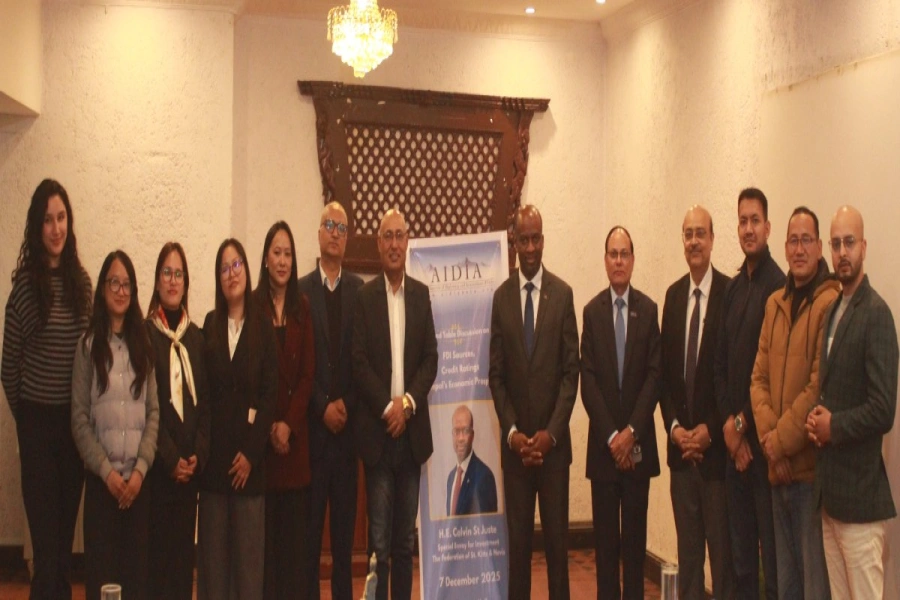
KATHMANDU, Dec 7: Nepal must urgently shift toward equity-based investment and regulatory reforms as the era of ‘free capital’ is expected to end after 2026, when the country graduates from the Least Developed Countries (LDC) category, experts have urged.
“The era of free money ends,” said Calvin St. Juste, special envoy for Investment of the Federation of St. Kitts and Nevis, during a high-level roundtable in Kathmandu on Sunday. The event organised by the Asian Institute of Diplomacy and International Affairs (AIDIA) brought together senior banking leaders, media representatives and economic analysts to examine Nepal’s investment landscape, its credit ratings trajectory and emerging opportunities amid shifting global financial currents. “Grants fade and loans cannot sustainably replace them. Equity can,” he added.
St. Juste encouraged Nepal not to fear its graduation from LDC status, but to view it as a strategic inflection point. He argued that the country should transition away from reliance on loans and towards equity-based financing, particularly in sectors such as hydropower, where domestic capacity is strong but international capital remains essential. “Political uncertainty is temporary,” he said. “Challenging or not, this is the moment to attract investors.”
Lending slows as banks focus on recovery of loans at fiscal yea...

According to Nepal Rastra Bank, St. Kitts and Nevis was among Nepal’s top five sources of Foreign Direct Investment (FDI) in 2020–21. Addressing misconceptions about ‘tax haven’ jurisdictions, St. Juste emphasised the importance of distinguishing competitive tax policies from illicit financial practices. “Tax competitiveness is not illegal,” he said. “Tax avoidance is legal; tax evasion is not. Don’t be fearful of designing a system that allows your economy to thrive.”
Drawing on the experience of St. Kitts and Nevis, which faced bankruptcy in 2005 after decades of dependence on the sugar industry, St. Juste highlighted the benefits of pivoting from reliance on commodities and concessional aid to attracting FDI and fostering investment-driven resilience.
He also noted structural parallels between the two nations. “Nepal is landlocked, whereas St. Kitts is sea-locked,” he said. “In different ways, we are both small states whose destinies can be profoundly shaped by external forces.”
Referring to Nepal’s BB– credit rating from Fitch, St. Juste noted that political unpredictability has led to growing investor hesitation. “As investors, you cannot control politics, but you can control risk,” he said, urging Nepal to address systemic vulnerabilities proactively.
Ram Kumar Tiwari, CEO of Nepal SBI Bank, noted that investors have begun pulling back due to current political uncertainty. Meanwhile, Ananda Jha, CEO of CARE Ratings Nepal Ltd, highlighted structural challenges within the country, including conflicts among multiple regulators—Nepal Rastra Bank (NRB), Securities Board of Nepal (SEBON) and Electricity Regulatory Commission (ERC)—which often result in fragmented or ad hoc policy outcomes. Despite a growing capital market and rising entrepreneurial activity, Nepal lacks meaningful international access.
Participants also flagged liquidity constraints, rigid labour policies, and a working culture misaligned with global productivity standards. While recognising the importance of an eight-hour workday, they stressed that technology and artificial intelligence now enable significantly higher output without extending working hours.
High tax rates—corporate taxes of 20–25 per cent and personal taxes up to 39 per cent—were also cited as deterrents to large-scale investment. Experts questioned the justification for high taxes without visible improvements in public services, underscoring the importance of customer-centric governance.
Sudyumna Prasad Upadhyaya, CEO of Sanima GIC, highlighted the performance and profitability of insurance and reinsurance companies in the Caribbean, including St. Kitts and Nevis, during the discussion.