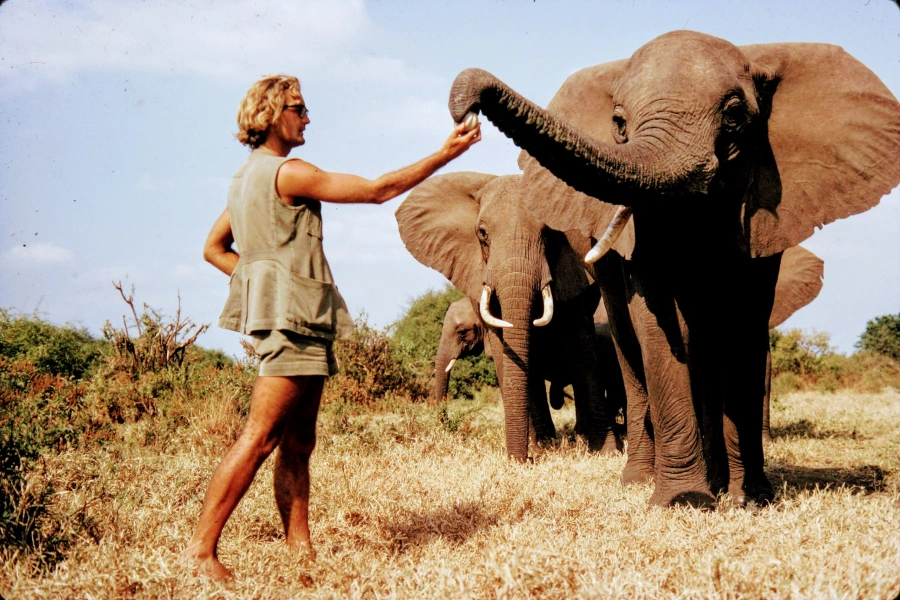
During the second week of December 2025, the world lost the renowned scientist, elephant expert, and conservationist Iain Douglas-Hamilton. Douglas-Hamilton breathed his last at the age of 83 in the capital city of Kenya, Nairobi. His departure toward the end of 2025 is not merely the death of one individual, it should be taken as the resting of a living history of elephant conservation.
Dr. Vivek Menon, Chair of the IUCN Species Survival Commission and an elephant-expert paid tribute to Douglas-Hamilton by writing, ‘Iain Douglas-Hamilton was to African elephants what Jane Goodall was to chimpanzees. If elephants were to speak a tongue that we, the thinking ape, could decipher then he would be described by them in the several avatars they saw him as: student, teacher, expert, ambassador, protector and warrior.’ This Scottish scientist spent more than six decades of his life following the footsteps of elephants, living out his days in the heart of the savannah in Africa.
Douglas-Hamilton’s journey began from a life of luxury in Britain. He transitioned into a life of study and research in the wilderness of Africa. After completing his education at Oxford University, he reached Tanzania in the 1960s. In those days, the study of elephants was something conducted only from a great distance. Hamilton developed a modern style of observing elephants from a very close range. He spent his time there in Lake Manyara National Park, where he studied the social behavior of more than 500 elephants.
He recognized every single elephant based on the shape of their tusks, the notches in their ears, and the wrinkles on their skin. Douglas-Hamilton used to say that elephants were not just animals, but that every elephant possessed its own personality, distinctiveness and consciousness.
The Foundation of Modern Elephant Science
I did one of my research projects on elephants in the easternmost region of Nepal,examiningtheir interactions with human society. In reviewing the relevant literature, the research conducted by Douglas-Hamilton consistently appears as the foundational and most frequently cited references in elephant research. As a pioneering elephant expert, Douglas-Hamilton spent all his life’s energy on this cause. It would not be wrong to say that the social knowledge we have acquired regarding elephants is, to a large extent, the result of his studies.
During his research in 1973, a documentary based on his work titled ‘The Family Who Lives with Elephants’ was broadcasted. It left the entire world astonished. This was a time when most people were terrified at the sight of an elephant. Douglas-Hamilton, however, lived in the midst of an elephant herd along with his two young daughters and his wife.
The 51-minute documentary, covering five years of his study, shows Hamilton’s family enjoying life in the savannah relying only on a small tent and a jeep with the number ‘TDP 462’. In that same jeep, he would go on safaris with his daughters and wife. In many instances, elephants and other wild animals would chase their jeep. On Douglas-Hamilton’s face, one could see not fear, but a deep intimacy. He was often found sitting comfortably in the middle of a herd of elephants, wearing huge sunglasses and writing his research reports on a typewriter.
Lack of conservation area for rare tea plant

Today, the typewriter has been replaced. Most work can be done with a single mobile phone. But raising his two infant daughters in the proximity of wild elephants was a courageous step. This move was also a symbol of the deep trust between elephants and humans. For this, he will be remembered for ages.
It made Douglas-Hamilton’s family look as though they were living as a part of the ‘Elephant Family’. This documentary, presented in an extremely interesting manner caught the attention of many. After falling in love with Douglas-Hamilton, his wife also left her profession as a fashion designer and transformed into a wildlife photographer.
Transition to the Frontlines: The War Against Poaching
While studying the social interaction and biology of elephants, his attention began to be drawn toward the death of elephants. In the 1970s, the illegal trade in elephant tusks (ivory) had reached its peak in Africa. Thousands of elephants were being killed across the continent. The elephant population had begun to decline at a terrifying rate. Seeing this, it was no longer possible for him to remain just a researcher. In his hands, there was now not just a pen and a typewriter, but a rifle as well.
Flying a single-engine plane at low altitude he counted dead elephants. He tracked the activities of poachers. Sometimes, poachers would even fire bullets at his small aircraft. His wife would be with him in the plane as well. But Douglas-Hamilton did not back down. Recording elephant deaths, he decided to involve himself with the intention of controlling poaching. He decided to use a gun. He learned to fire. The hands that once carried a typewriter and a pen now held a gun. He stood against poaching. He ran campaigns. He brought the incidents of illegal trade and smuggling of elephant ivory to the surface through scientific findings. After a harsh struggle, he was successful. In 1989, the international trade in ivory was banned.
Conservationist Jane Goodall also praised his work. In a documentary released by Save the Elephant, Goodall says, ‘Douglas-Hamilton brought elephants closer to humans and succeeded in creating a global public opinion against illegal hunting.’ Goodall also died on 1st October of 2025.
After the ivory ban, he established a conservation organization ‘Save the Elephants’ in 1993. This organization has supported elephant research and conservation initiatives across the world, including Nepal. Through this organization, he continued to track elephant movements and behavior using GPS collaring and long-term field studies. Save the Elephants has also been a pioneer in developing solutions to human–elephant conflict. One notable initiative, the Elephants and Bees Project, reduces crop raiding by using beehive fences that exploit elephants’ natural avoidance of honey bees, while also providing livelihood benefits through the production of‘elephant-friendly’ honey.A documentary covering his work was published in 2010, which was also shown as a video related to the Indianapolis Prize, where he spoke in detail about these subjects.
A Global Perspective: Collaboration as Path Forward
In around 2009, elephant poaching surged once again, reaching particularly alarming levels between 2010 and 2012. Some organizations estimated that more than 35,000 African elephants were being killed each year. If this trend had continued unchecked, African elephants could have faced extinction within just a few decades. Once again, Douglas-Hamilton emerged as a leading global voice, urgently calling for action to save elephants.
For a long time, much of the international conservation community attributed this renewed elephant crisis primarily to China. The rapid growth of China’s middle class and rising demand for ivory were widely seen as the main drivers of illegal trafficking and elephant poaching. As such, China was often portrayed as the ‘villain’ in global media narratives. Douglas-Hamilton, however, took a more inclusive view. He acknowledged that China was part of the problem, but he also recognized that it could—and must—be part of the solution.
Dr. Yufang Gao, Co-Chair of the IUCN China Species Specialist Group, describedDouglas-Hamilton to the author as’an amazing mentor and friendwith a remarkable combination of intellectual rigor and open-hearted collaboration.’ Between 2012 and 2014, Gao conducted extensive research on the China–Africa ivory trade while completing his master’s degree at the then Yale School of Forestry & Environmental Studies. During this period, he had numerous conversations with Douglas-Hamilton at conferences and campaigns, in the field, and at his home and aboard his helicopter. Gao recalled that at a time when global discourse often reduced China’s role to a simplistic narrative of ‘villain,’ Douglas-Hamilton stood apart. He was genuinely willing to engage with Chinese researchers to understand the social and cultural complexities of ivory consumption and to work collaboratively with Chinese conservationists toward shared solutions.
It was Douglas-Hamilton who welcomed Chinese public figures, including Yao Ming and Li Bingbing, to his field camp in Kenya's Samburu National Reserve helping them witness firsthand the realities of elephant poaching and ivory trafficking. Through their influence, these figures brought conservation messages back to the Chinese public. He also supported Dr. Gao in facilitating exchanges that brought Kenyan conservationists to China to engage directly with their Chinese counterparts, increasing dialogue to build a broad, transnational coalition for elephant conservation.
At the 2017 ‘Wildlife Conservation Expo,’ sharing the stage with Jane Goodall, he praised China, breaking the prevalent perceptions regarding their stance on wildlife conservation. The Chinese government permanently banned the trade of elephant trophies and ivory. For this act, he also thanked the superpower America, mentioning then-US President Barack Obama and Chinese President Xi Jinping. At that expo, he said, ‘China was made a villain for no reason, but China has made a 360-degree change in its policy regarding elephant conservation.’
Resilience and Legacy
The year 2010 became a tragic year in Douglas-Hamilton’s life. A massive flood in Samburu National Park washed away his research center. The mud destroyed years of hard work, data and documents containing important memories. In that flood, many ‘grandfather’ elephants that he had studied were also killed. Even when his entire life’s earnings (research materials) were washed away by the flood. Douglas-Hamilton did not waver. He started his work again from zero. He used to say, ‘I love to hear the voice of elephants, to hear the sound of their tough skin rubbing against each other and to live in their scent.’
In the words of elephant researcher Dr. Sanjeeta Sharma Pokharel, Douglas-Hamilton is the ‘Titan’ of the field of elephant study. He began his research during an extremely challenging time and even put his life at risk to stop the illegal trade of elephants. In a conversation with this author, Dr. Pokharel said that Douglas-Hamilton looked at elephants not just as a species, but as a separate social civilization. She said, ‘It was he who taught us that elephants also have sorrow, happiness, and families.’
To Dr. Gao, Douglas-Hamilton was not just a pioneering scientist but also a highly respected colleague to those who had the opportunity to work with him. Gao, recalling precious personal moments with him said, ‘Iain was very generous in supporting young conservationists. His belief in the power of cross-cultural engagement and collaboration had shaped the efforts to address the interlinked challenges of elephant poaching and ivory smuggling.’
Though he left the world at the age of 83, ‘Save the Elephants,’ which he established, the herds of elephants he fitted with radio collars, and the many conservationists inspired by him, will always keep his existence alive in the plains of Kenya and Tanzania. When a herd of elephants walks through the African plains kicking up dust, the shadow of Iain Douglas-Hamilton will surely be seen somewhere there. The existence of elephants and Douglas-Hamilton’s legacy will now echo not only in the pages of history but also in the future of conservation. During the last decades, he believed in creating human-elephant co-existence to reduce the conflict issues.
In one of his documentaries he said, ‘I love the smell of elephants, I love to live with them, I feel happy when they are around, I love to hear their voices, to hear the sound of their tough skin rubbing against each other. I love to watch them playing; I feel the realization of happiness only when I am with them. I feel extremely peaceful.’
Farewell, Legend.
(The author is a passionate science writer and currently working as a conservation officer at National Trust for Nature Conservation.)