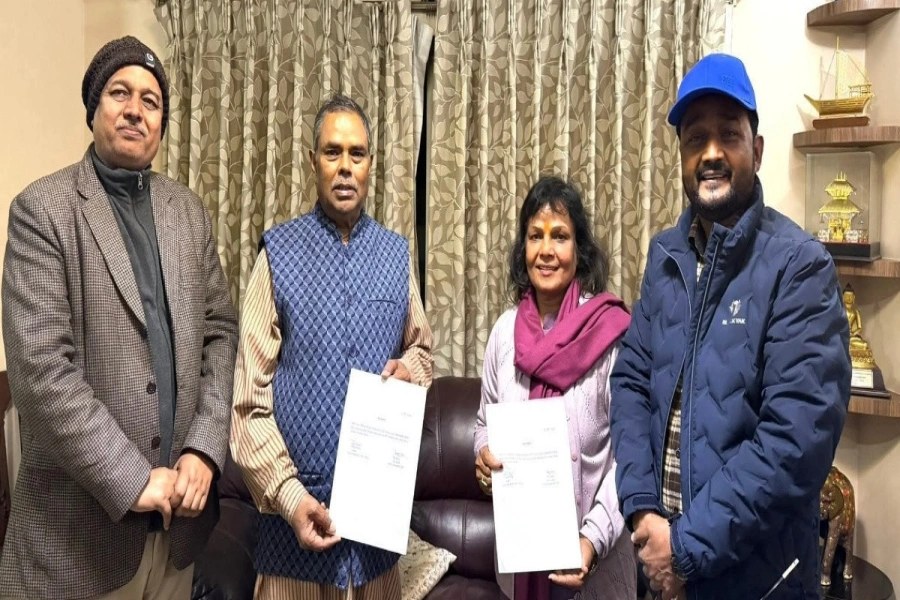
KATHMANDU, Dec 30: Upendra Yadav-led Janata Samajbadi Party Nepal (JSP-N) and Mahanta Thakur-led Loktantrik Samajbadi Party Nepal (LJP-N) have reunited after four years, marking a significant development in Madhesh-centric politics.
Vice-chairs Renu Yadav and Pradeep Yadav also returned with the majority of central members, strengthening the unified front. Analysts say the merger signals a move beyond narrow regional and community-based politics.
The reunification comes after Balendra “Balen” Sah joined the Rastriya Swatantra Party (RSP) to institutionalize the Gen Z movement, which has put pressure on regional parties in Madhesh. The recent Gen Z uprising, though seemingly an external event, has fundamentally highlighted issues of good governance and generational change, along with concerns about corruption and the use of state power.
EC makes public the list of 95 political parties

Political analyst Tulanarayan Sah has noted that the current polarization of national politics—old parties versus new—is a direct outcome of the movement, and Madhesh politics cannot remain unaffected. He says the consolidation of Madhesh-centric parties is more a strategy for survival than a voluntary alignment, but it will send a positive message to voters and likely yield political and electoral benefits.
Madhesh-centric parties have historically split and merged repeatedly, often due to leadership conflicts, power struggles, or proximity to government. The Madheshi Janadhikar Forum, established in 2054 BS, experienced multiple splits and mergers over the years, including the formation of Loktantrik Madheshi Janadhikar Forum and other offshoots.
Similarly, the JSP Nepal, initially formed in 2077 BS from the merger of the Rastriya Janata Party and the Samajbadi Party, fractured within two years due to internal disputes, weakening Madhesh representation. Analysts note that unity increases the political weight of Madhesh votes, while fragmentation diminishes influence and public trust.
The latest unification decisions were taken during a meeting in Kathmandu attended by party leaders, including Yadav and Thakur. The parties agreed to strengthen federal democracy, proportional inclusion, social justice, and the rights and identity of Madhesh. Following this, JSP Nepal merged with Ashok Rai-led Janata Samajbadi Party, led by Vice-Chair Renu Yadav, consolidating central members and forming a stronger political bloc.
Political observers say Madhesh-centric parties often unite during struggles with the central government but split once in proximity to power—a pattern that has repeatedly weakened Madheshi influence. The current unification, however, is seen as a crucial opportunity to rebuild a strong, cohesive Madheshi political force. “When united, Madhesh votes carry more weight. When divided, even the core issues of Madhesh are weakened,” says Professor Bhogendra Jha of Janakpur. Experts add that if this unity is maintained, it could restore public confidence in Madhesh politics and strengthen the region’s voice in national decision-making.
The ongoing consolidation marks a new phase in Madhesh politics, reflecting lessons from past divisions while responding to contemporary political challenges. While the unity is partly driven by necessity, it has revived hope and enthusiasm among Madheshi voters. The coming months will determine whether this reunification can sustain itself and translate into effective political influence at both regional and national levels.