

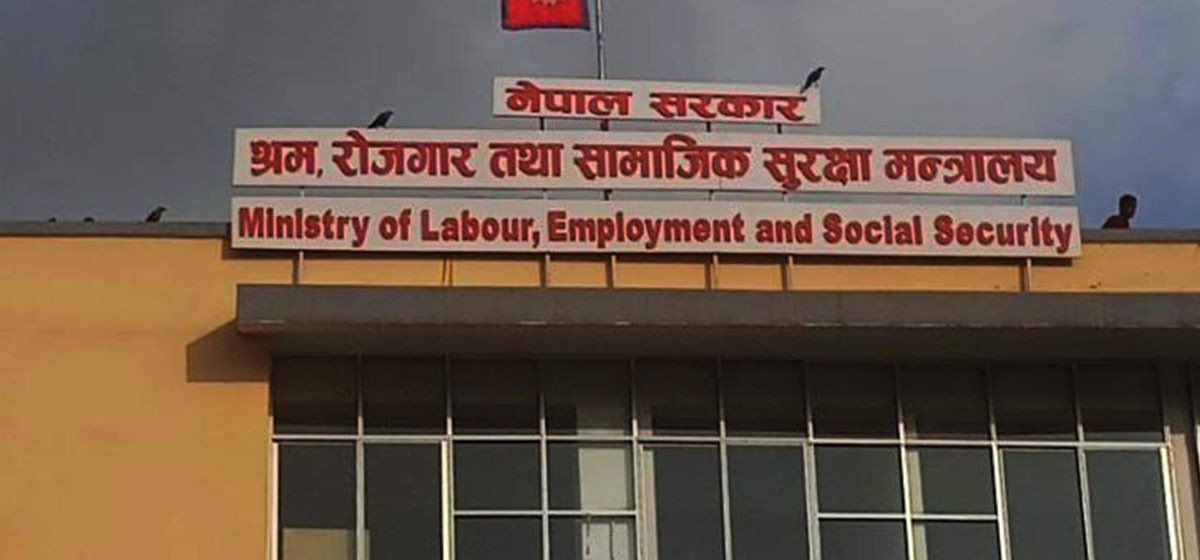
KATHMANDU, Aug 9: In a move that has raised eyebrows, the Ministry of Labor, Employment, and Social Security (MoLESS) has approved a controversial directive allowing private manpower agencies to send Nepali workers to South Korea—sparking fears that the well-established, low-cost government-to-government (G2G) Employment Permit System (EPS) could be undermined in favor of vested interests.
Every year, more than 11,000 Nepali workers travel to South Korea under the EPS framework, a model praised for its transparency and minimal cost. Under EPS, aspirants pay around Rs 52,000 for airfare and an additional $61 in official fees. In sharp contrast, those going through manpower agencies could face charges upward of Rs 600,000 to Rs 700,000—a staggering financial burden, especially for low-income aspirants.
Sources inside the MoLESS admit that the directive was pushed through under pressure from manpower companies who stand to benefit significantly. Critics argue this abrupt shift in policy, especially when the G2G system is functioning efficiently, hints at questionable motives and possible collusion between ministry officials and the private recruitment lobby.
While the ministry insists the new directive won’t affect the EPS model, insiders disagree. “The claim that EPS won’t be affected is misleading,” said one ministry official. “This new provision opens a backdoor for manpower companies to gradually take control of Korea-bound labor quotas. It’s a clear loophole that will be exploited.”
DoFE refuses to file complaints against defrauding manpower com...

The directive allows manpower companies to recruit skilled workers under South Korea’s E-7 visa category through a business-to-business (B2B) model. In contrast, the unskilled E-9 visa, currently managed under the G2G EPS system, remains unchanged—for now. However, fears remain that the creeping influence of the B2B model could eventually erode the G2G framework.
“The concern is not just about the cost,” said a labour rights advocate. “It’s about accountability, transparency and the long-term erosion of a public system that protects workers.”
MoLESS officials claim the B2B model will only apply to technically skilled workers like plumbers, drivers, or hairdressers. Yet critics warn that even under this category, the manpower agencies will gain disproportionate power by controlling quotas and recruitment processes. Past experience suggests they are likely to charge arbitrary and excessive service fees, despite official limits.
Currently, the EPS branch under the Department of Foreign Employment handles Korea-bound recruitment through a systematic process—ranging from application calls, exams to data management. The new B2B provision bypasses this structure, instead allowing manpower companies to deal directly with Korean firms. The Nepali embassy in Korea will simply authenticate the quota, which is then uploaded into a database and distributed to manpower agencies—leaving plenty of room for manipulation.
Under Secretary Tika Ram Dhakal admitted that Korea has not yet officially requested any labor quota via manpower agencies and said he had no information on whether the Nepali Embassy in Korea had been informed.
Further fuelling suspicion is the timing of the directive. Labor Minister Sharat Singh Bhandari is said to have pushed the directive through hastily amid political pressure within his party. His party, the Loktantrik Samajwadi Party, has already asked Prime Minister KP Sharma Oli to remove Bhandari and replace him with Sarbendra Nath Shukla.
A MoLESS source alleged that Bhandari rushed the decision to curry favour with powerful manpower companies before his expected exit from office. Secretary Krishna Hari Pushkar is also believed to have played a central role in endorsing the directive.
Labor experts are warning that this decision could set a dangerous precedent. “Once the door is opened to private players, it is only a matter of time before the G2G system is sidelined,” one expert said. “And when that happens, workers will once again become hostages to an exploitative and profit-driven recruitment industry.”






-1782125987.webp)
-1200x560-1782120651.webp)


