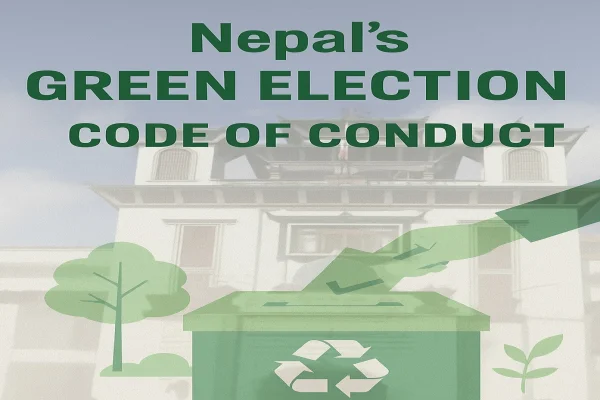
KATHMANDU, Dec 29 : The Election Commission (EC) has tightened its election code of conduct for the March 5 House of Representatives election, formally banning the use of Artificial Intelligence (AI) to influence voters and prohibiting election campaigning in schools, universities, and other public institutions effective from January 15 in a bid to safeguard electoral integrity.
With the polls approaching, the EC has issued an updated and expanded code of conduct aimed at ensuring a free, fair, and transparent electoral process. For the first time, the code places special emphasis on digital ethics by explicitly incorporating restrictions on the use of AI, banning its deployment to influence voters through disinformation, defamation, deepfakes, misleading content, hate speech, or derogatory remarks on social media.
The code also prohibits manipulating or altering published materials using AI, as well as coordinated online activities such as reposting, commenting, tagging, live streaming, or mentioning content with the intent to mislead voters.
Operating fake social media accounts or websites to undermine the electoral process has been strictly barred. The EC has also prohibited opinion polls, surveys, projections, or the publication of election results from the date of candidate nomination until voting concludes.
To protect the sanctity of the polling process, the code bans photography or videography at polling and vote-counting centers using cameras, drones, mobile phones, or any other devices without prior authorization.
Alongside digital restrictions, the Election Code of Conduct places firm limits on physical campaigning. Political parties and candidates are prohibited from holding election-related meetings or activities on the premises of schools, universities, colleges, government or semi-government offices, and other public institutions. The use of government or public resources to support or oppose any party or candidate is also banned.
The code further restricts the production, sale, distribution, or display of election symbol-branded materials such as clothing, caps, scarves, masks, badges, bags, or tattoos. Campaigning that harms the dignity or sentiments of senior citizens, women, sexual and gender minorities, or persons with disabilities is prohibited, as is the use of children for political publicity.
In addition, campaign activities that obstruct public movement—such as rallies, processions, or large gatherings—are not allowed, and the spread of false, misleading, or hateful content on social media is strictly forbidden.
The Election Commission said the strengthened code reflects growing challenges posed by digital manipulation and aims to preserve electoral integrity while ensuring respectful, inclusive, and lawful campaigning throughout the election period.
Regarding the use of vehicles in election campaigns, only two pre-registered chief campaigners are permitted to use helicopters. Spending limits under the proportional representation system have been set based on the number of closed-list candidates.
Vehicles approved by election officials may be used to assist pregnant women, new mothers, women carrying infants, mourners performing last rites, persons with disabilities, senior citizens, and others unable to walk.
Candidates are also barred from using unauthorized vehicles for campaigning or displaying campaign materials. In case of violations, traffic police or security personnel are authorized to seize the vehicles and report the matter to the district-level Code of Conduct Monitoring Committee.
Related story
EC issues ‘Green Election’ code of conduct for March 5 polls