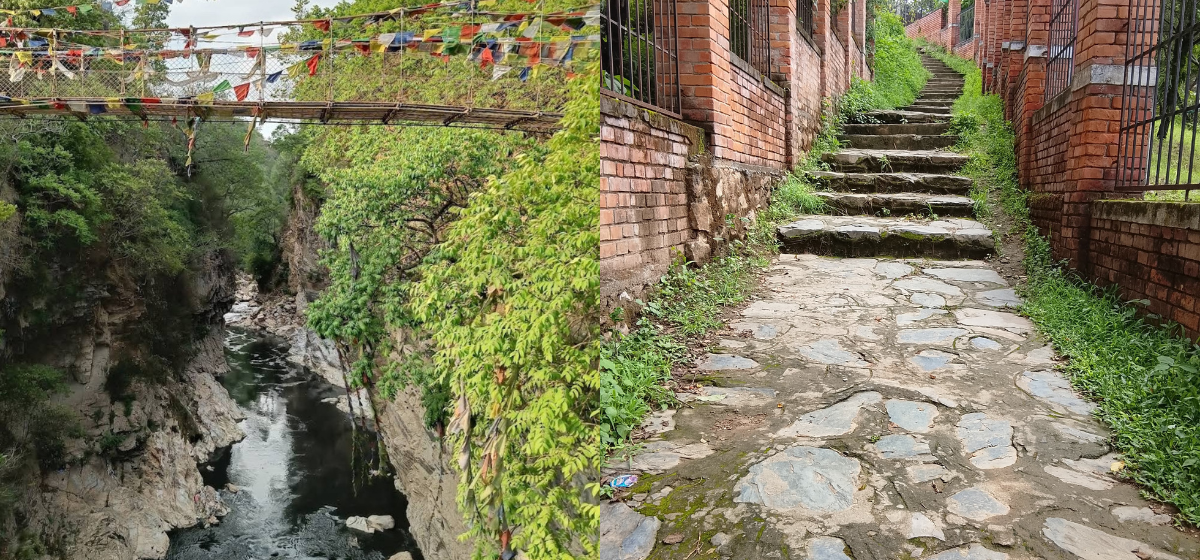
KATHMANDU, July 19: Tucked along the southern rim of Kathmandu Valley, Chobhar hill is slowly emerging from the shadows of neglect into the light of curiosity, tourism, and cultural pride. Its landscapes are no longer just dotted with suspicious dogs eyeing the strangers, strutting chickens, the old settlements of Newar, and children playing around and chasing each other after school—they now host morning joggers, weekend tourists, and curious seekers of history. But long before zip-lines or selfie spots, long before concrete paths, this hill held legends—etched in rocks, passed through generations, and now, carved quite literally into the very walls of its caves.
At the heart of Chobhar’s mythic origin lies Manjushree, a revered Bodhisattva in Mahayana Buddhism. He descended from Mount Wutai in China and saw that the Kathmandu Valley was a giant lake. He sliced open the hills of Chobhar with his flaming sword, allowing the waters to drain. Where water once reigned, fertile plains emerged. And the Kathmandu Valley, as we know it, came into being.
Gyanendra Tuladhar, 61, popularly known as Gyanu Dai in Chobhar, shares, “My elders told me these stories when I was young. There was no park back then, just hills. It was our hangout area, and we didn’t need any tickets either.”
As the waters drained, Manjushree is also believed to have placed the Nagas from the lakes to Taudaha—carrying them safely there, which today sits as a serene ecological and tourism site, still home to myths and migrating birds alike.
Gyanu Dai explains, “Back then, before the park, we explored the caves freely as they were not sealed. People carved their names just in case they went missing so their friends or families could find them. It wasn’t for trend or defacement, but a safety mark. Now, though, the youth carve things on walls for fashion. The old ones had meaning.”
Manjushree Park in limbo as jurisdiction dispute drags on

Long before smartphones or social media “check-ins,” early humans carved their stories into stones. Early Homo sapiens left behind handprints, symbols, and animal sketches—not as vandalism, but as memory, prayer, and presence.
Anthropologist Clifford Geertz, in The Interpretation of Cultures (1973), defined culture as “a system of inherited conceptions expressed in symbolic forms by means of which men communicate, perpetuate, and develop their knowledge about and attitudes toward life.” Etched names, faded hearts, cracked dates on Chobhar’s rock surfaces may seem crude at first glance, but they too are symbols—marks of presence, yearning, or rebellion.
Established in 2062 BS, Manjushree Park now stands as a structured gateway to Chobhar’s myths. Built and managed under the Jal Binayak Community Forest Users Group, the park is a community-driven eco-tourism site, under the jurisdiction of the Forest and Environment Ministry.
Deepak Maharjan, president of the group, elaborates, “This place holds immense historical and cultural value. There are seven interconnected caves—like Manjushree Gufa, Bagh Gufa, Naya Gufa—these interconnected caves are South Asia’s second longest at 1200 meters. It would take a person about four hours to explore them.”
Maharjan explained that before people used to explore the caves freely; now they are sealed off and guided tours are offered. It is for the conservation of the site and people’s safety. There are areas where there is lack of oxygen, narrow spaces where one may need to crawl to move forward, and hence having a guide is important.
Despite the growing popularity, a strange contradiction unfolds here: while the park celebrates memory, it also struggles with it. Rock surfaces are marked with carved initials. Visitors litter the place. Maharjan says “We need to manage it. We place instruction boards to not litter, have separate waste bins, and make community announcements for cleanup campaigns. The awareness is growing slowly; it is a gradual and social process. We hope that with time people would develop self-awareness to not harm these places. “During the early hours of mornings, one could also find the people from community—cleaning up the place with dedication and Doko (traditional baskets to collect waste).
Maharjan admits that Chobhar once carried a stigma. “Back in college, I would say I was from Kirtipur instead. Saying you were from Chobhar felt low. But now, people proudly say they’re from here. The park, the Adinath temple, the stories—they’ve become identity markers.”
As carvings continue across the walls of Manjushree Park, questions arise: Who carved them? Why? Are they mere scribbles of teenagers or adults? Perhaps, this need to leave marks is deeply human—a cry against mortality. Just like ancient handprints on cave walls, today's initials might be an instinctive act to be remembered. But context matters. These markings, when left unchecked, can damage not only the aesthetics but the structural and ecological integrity of heritage sites.
Perhaps it is time we acknowledge this impulse not with scolding, but with redirection. A designated space where people can write or draw, without harming heritage like a ‘memory wall’, where people could leave notes behind, if they wish to.Maharjan nods at this idea, “A ‘Memory Wall’? I think that’s a good one. We could think about it. It’s about balance.”
Chobhar hills, once just a weekend escape, are now a site of legend, faith, and cultural rebirth. But like the faded names on stone, it bears the tension between being remembered and being ruined. Perhaps the answer lies in creating spaces where memory and respect can coexist.
And maybe, as we look up at the quiet hills echoing the tales of Manjushree and Adinath with their synthesis of cultures, we realize that the most powerful carvings aren’t those on stone, but those etched in stories, passed from grandparent to child, told again and again—until they, too, become legends.