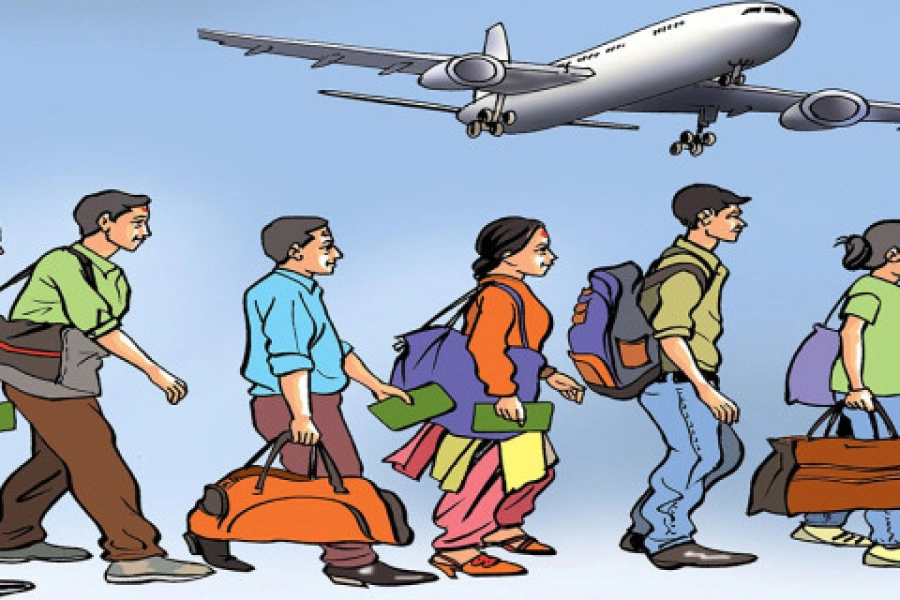
KATHMANDU, Feb 21: He leaves his village with a borrowed dream — and borrowed money. A poor young man arrives in Kathmandu hoping to secure a job abroad. But before he ever boards a plane, he is compelled to spend nearly Rs 30,000 — including food and lodging — in the name of mandatory medical tests. When the promised job falls through, the debt does not.
This has become the quiet, crushing reality of thousands of Nepali workers. What should be a routine health check has, many allege, turned into an organized system of extraction — a “medical mafia” thriving in the shadows of foreign employment.
Medical tests are reportedly conducted on far more workers than destination countries actually require. Even before jobs and destinations are confirmed, aspiring migrants are repeatedly sent for examinations. These irregularities have cast serious doubt on the effectiveness of the state’s regulatory oversight.
The Ministry of Labour, Employment and Social Security (MoLESS) has alleged the existence of a deep-rooted syndicate manipulating the medical process for migrant workers. A task force formed by the ministry is investigating health institutions accused of issuing fake reports, forcing multiple tests, certifying unfit individuals as fit, and charging fees beyond government-set limits.
Complaints had surfaced for years, but monitoring remained weak. Recent inspections, however, have led the ministry to conclude that the sector has slipped into mafia-like control.
Nobel-worthy

According to a MoLESS official, workers heading to Gulf countries and Malaysia are often forced to undergo medical tests even before their jobs are finalized. A single round of testing — including travel to Kathmandu, food, and accommodation — can cost between Rs 25,000 and Rs 30,000. Repeated testing, officials say, pushes many into a cycle of debt before they even secure employment.
Allegations have also surfaced that Clause 45(b) was added to regulations in 2075 BS to legitimize the syndicate, with financial dealings allegedly extending into political and administrative circles. Critics argue the provision benefits a limited number of medical centers and manpower agencies.
Inspections led by two joint secretaries from MoLESS, supported by police, are ongoing. Investigators claim that even when a foreign employer needs only 70 workers, medical tests may be conducted on up to 700 applicants — with manpower agencies and medical institutions allegedly sharing the proceeds. The practice not only defrauds workers but also drains state revenue.
Although health examinations are legally mandatory for foreign employment, many workers certified as “fit” in Nepal have been declared “unfit” upon arrival abroad and forced to return home. While compensation is mandated by law, victims say receiving it is extremely difficult. Government studies have also indicated cases where medical reports were issued without proper examinations, putting workers’ health and lives at risk overseas.
Manpower companies registered with the Department of Foreign Employment are alleged to be complicit in repeated testing, fake reporting, document manipulation, and overcharging. These practices undermine the government’s claim of making foreign employment safer and more transparent.
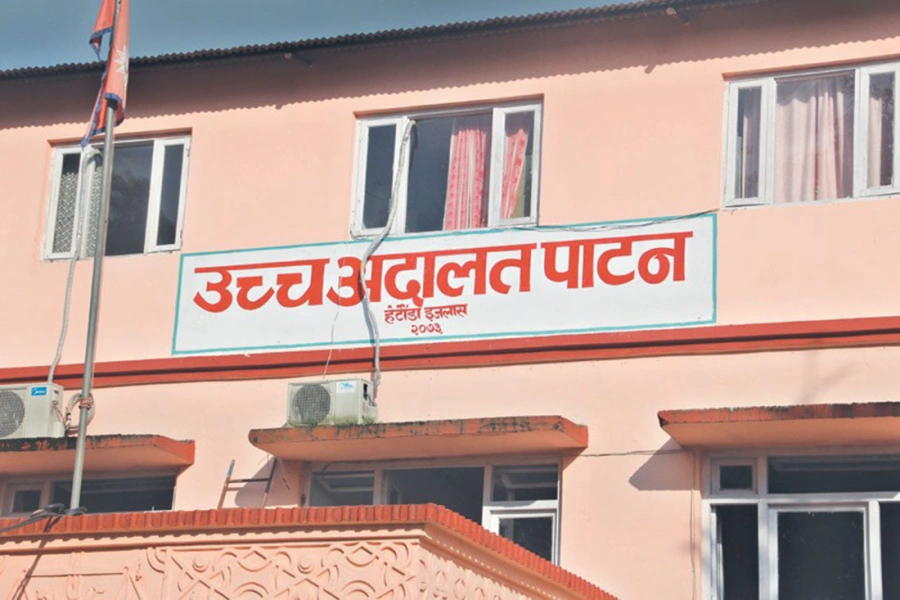
Former Labour Minister Sharat Singh Bhandari had once proposed expanding mandatory tests to 34 types and raising the fee from Rs 6,500 to Rs 9,500. Public backlash stalled the move. The current minister, Rajendra Singh Bhandari, later scrapped the decision. Although the matter reached court, no interim order was issued, meaning the official fee remains Rs 6,500 — yet workers say some centers continue to charge more.
The task force reports inspecting over 50 health institutions and related offices so far, with most allegedly found violating legal standards.
Officials have also raised concerns about billions of rupees circulating through the medical sector, including possible money laundering and capital flight. The matter has been brought to the attention of Nepal Rastra Bank and the Ministry of Finance.
Despite facing pressure from multiple quarters, an official involved in the investigation said the task force remains committed to confronting the syndicate. They argue that the medical racket is damaging not only the future of poor workers but also the national economy.
Task force members insist they are aligned neither with any minister nor political interest, but with “good governance” and the protection of grassroots workers. Their stated goal is simple: to stop the exploitation.
As the team prepares to make its findings public, the case has raised uncomfortable questions about the roles of Nepal Police, the Ministry of Foreign Affairs, and the Department of Foreign Employment.
For thousands chasing opportunity abroad, the first hurdle should not be a trap. Whether reforms will follow — and whether accountability will reach the powerful — remains to be seen.