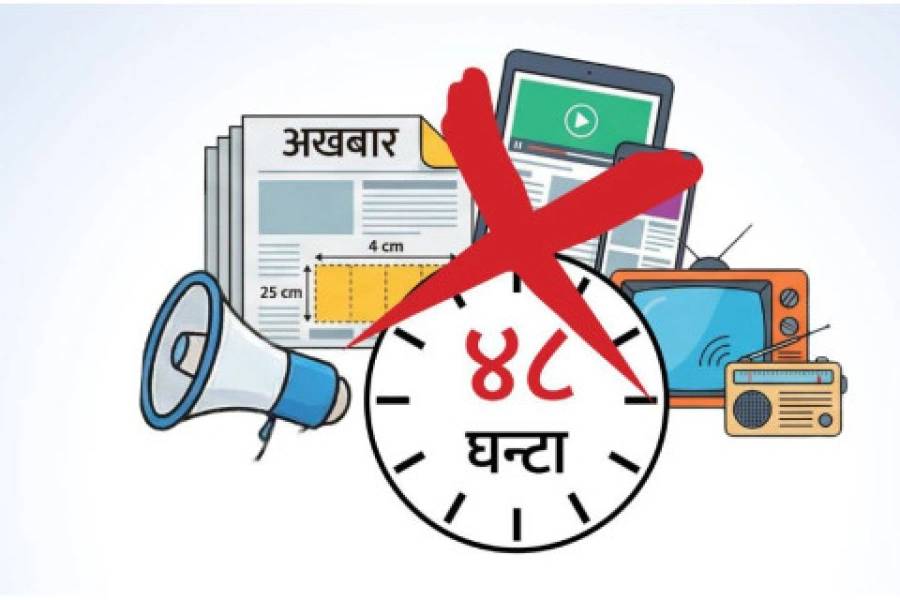
LAHAN, March 3: As the clock struck midnight on Monday, the silence period for Thursday’s election officially began. Campaign slogans faded, loudspeakers went quiet, and public rallies ceased.
Under the election code of conduct, candidates are barred from any form of campaigning or election-related activity during this time. Yet, paradoxically, it is in this enforced quiet that the most intense political maneuvering unfolds. Experience shows that many of the biggest electoral upsets are scripted during these silent hours.
In Madhesh, the silence period is often whispered about as the “night that changes the result” — even the “night of slaughter.” Behind closed doors, candidates negotiate for neutral votes and those in impoverished settlements. Even at the eleventh hour, seemingly certain victories can unravel.
Silent period' is time for voters, candidates and EC to reflect...

Numerous past elections bear witness to dramatic turnarounds engineered during this narrow window. The contest begins anew on the first night of silence and runs right up to the eve of polling day. Observers say that with many candidates in the fray now financially powerful, the flow of money this time could surpass previous elections. In Madhesh, they argue, electoral arithmetic is often settled not on the campaign trail, but in the silence period.
Community leaders continue to wield decisive influence. In areas under their sway, they can still deliver votes en bloc to a preferred candidate. In return, candidates provide fixed sums of money — often calculated according to the number of votes a leader claims to command. “Some leaders even pledge a specific vote count in exchange for payment,” said a political worker. “If the promised votes fail to materialize, there are instances where the money is demanded back after the election.” Past elections have seen money reclaimed — and in some cases, violence — when commitments were not fulfilled.
Another practice quietly unfolds: candidates who sense defeat sometimes accept additional funds from stronger rivals under the guise of campaign expenses and shift their support. This election, observers estimate that nearly 40 percent of voters across Madhesh’s villages and towns remain publicly undecided. “Whichever way these votes swing, victory follows,” another political worker said. “That’s why candidates deploy every tactic — persuasion, money, coercion, division — to capture the silent vote.”
In Dalit and impoverished settlements, the movement of unfamiliar faces has grown noticeable. After dark, strangers arrive. A woman from the Saday settlement in Siraha Constituency-2 said, “They are telling us, ‘Vote for us, and we will help you whenever you face problems.’”
She noted that people never seen before are now frequent visitors, attempting to woo voters. Parties that once campaigned aggressively in public are now turning their attention to these quiet corners. The Musahar settlement at Dhobiyadhar embankment in Golbazar Municipality-10, under Siraha Constituency-3, remains politically “silent.” With no firm allegiance to any party, such communities have become prime targets during the silence period.
“Until the silence period, campaigns only created a surface-level atmosphere — the real election begins now,” said a district-level party leader. “Here, results are shaped by the influence exerted on silent voters during these days.” According to him, strategies range from persuading community leaders and meeting voters discreetly to employing indirect formulas to tilt the balance. “There is little point in blaming one party or another,” he added. “Everyone uses whatever means they can afford to win.”
For many silent voters, the individual outweighs the party symbol. The candidate who connects personally during this crucial window often secures their ballot. Meanwhile, influential contenders mobilize workers to spread strategic rumors on the eve of voting — claims that certain candidates have withdrawn support, that rivals have been “bought,” or that a particular contender is already losing. Such whispers, designed to create momentum or doubt, have intensified.
In Madhesh, when the microphones fall silent, the real battle for the ballot quietly begins.