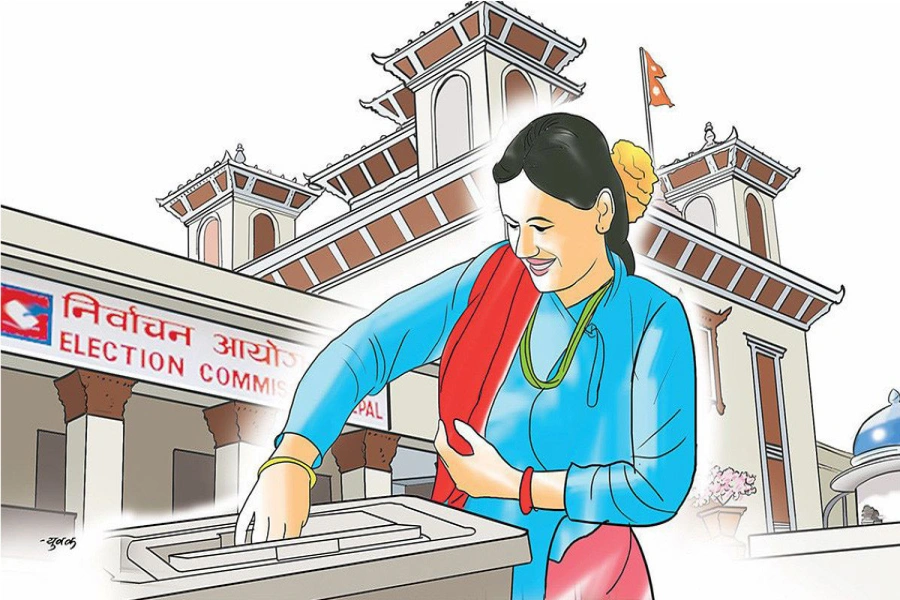
Nepal has just completed another election cycle. I did not vote. My decision was not the result of indifference. It was a refusal to participate in a democratic ritual that excludes millions of Nepali citizens who live and work beyond the country’s borders. When a nation depends so profoundly on people who cannot meaningfully participate in its political life, the act of voting begins to feel incomplete.
For decades Nepal has relied on its diaspora to stabilize the national economy. The most visible symbol of that dependence lies in the Gulf states, where hundreds of thousands of Nepali workers spend years under harsh desert conditions building the infrastructure of rapidly expanding cities. Roads, stadiums, apartment towers, ports, and industrial complexes across the Middle East carry the imprint of Nepali labor. These workers endure long separations from their families and often difficult working conditions in order to send money home.
The remittances they send back to Nepal form one of the central pillars of the economy. In many years these transfers account for nearly a quarter of the country’s gross domestic product. Entire villages depend on this income. Houses are built with it. Children are educated with it. Small businesses are launched with it. These workers have become the quiet financial backbone of the nation.
Yet the same workers whose sacrifices sustain the economy are often unable to participate meaningfully in the democratic process. Voting from abroad remains difficult or inaccessible for many of them. In effect, Nepal has constructed an economic system that relies heavily on citizens whose voices are largely absent from the political decisions that shape the country’s future.
This exclusion alone raises serious questions about the completeness of Nepal’s democracy. As the political theorist Robert A. Dahl wrote, democracy depends on the “continuing responsiveness of the government to the preferences of its citizens.” When millions of those citizens cannot realistically exercise their political rights, responsiveness becomes difficult to claim.
The issue becomes even more striking when one considers another segment of the diaspora. Across the United States, Canada, Europe, Australia, Japan, and New Zealand lives a rapidly growing community of highly educated Nepalis. Many belong to a generation that has studied in some of the world’s leading universities and works in fields such as engineering, medicine, research, finance, and technology. They are part of global networks of innovation and knowledge that are reshaping economies everywhere.
These individuals possess skills and perspectives that could help Nepal navigate a rapidly changing world. They understand emerging technologies, global markets, and new models of economic development. Yet they too remain largely detached from Nepal’s electoral system. Their ideas, their expertise, and their aspirations rarely enter the formal structures of political decision making.
‘Leverage diaspora expertise, investment and ‘soft power’ for N...

The result is a striking democratic imbalance. The workers who sustain Nepal through remittances and the professionals employed in the world’s leading institutions, who could help modernize its economy, both remain politically distant. One group contributes physical labor under difficult circumstances. The other contributes knowledge and intellectual capital. Both maintain deep emotional and financial ties to the country. Yet neither group is fully integrated into its democratic process.
The economist and philosopher AmartyaSen has argued that democracy should be understood not merely as elections but as a process of “public reasoning.” Excluding the diaspora narrows that reasoning at precisely the moment when Nepal most needs a wider conversation about its future.
Meanwhile the political conversation within Nepal continues to revolve around familiar promises of job creation and economic opportunity. Campaign speeches emphasize employment programs, infrastructure projects, and industrial development. These themes reflect a development model rooted in the twentieth century, a time when economic growth was closely tied to expanding labor markets.
But the structure of work itself is changing rapidly. Advances in artificial intelligence, robotics, and automation are transforming industries across the globe. Machines are increasingly capable of performing tasks that once required human labor. Algorithms analyze financial markets, interpret medical scans, write computer code, and manage supply chains. Autonomous systems are beginning to reshape transportation, logistics, and manufacturing.
Many economists and technologists now warn that the scale of this transformation could be unprecedented. Some projections suggest that a large majority of existing jobs could disappear or be radically transformed within the coming decade. In extreme scenarios, as much as ninety percent of current forms of employment could be automated or rendered obsolete by 2030. Whether or not such forecasts prove entirely accurate, they reflect a growing recognition that technological change is accelerating faster than social and political institutions are prepared to adapt.
For a country like Nepal, which has long depended on exporting labor to foreign markets, this possibility carries profound implications. The global demand for migrant workers may not remain constant. As automation spreads through construction, logistics, manufacturing, and services, the industries that currently employ Nepali migrants may gradually reduce their reliance on human labor. The cranes that once required large crews may operate with minimal personnel. Warehouses that once depended on hundreds of workers may function with fleets of autonomous machines.
In such a world Nepal’s economic model could face severe strain. If remittance flows decline while domestic job creation remains limited, the country may confront a future in which both external and internal labor markets contract simultaneously. The consequences would extend far beyond economics. Social structures built around migration and remittance income could begin to unravel.
This is where the absence of the diaspora from the democratic process becomes especially troubling. The people who stand at the center of these changes are precisely those who remain politically marginal. The migrant workers who experience global labor markets firsthand and the highly educated professionals who understand technological transformation are the very voices that could enrich Nepal’s debate about its future.
Yet their perspectives remain largely unheard in the country’s electoral system.
Political participation has always been central to democratic legitimacy. The political scientist Larry Diamond has written that democracy depends on “meaningful participation and inclusion of citizens in the political process.” When millions of Nepalis living abroad remain excluded from the vote, that principle of inclusion is weakened.
At the same time, younger Nepalis are increasingly aware that the future of work may look dramatically different from the past. Many members of the emerging generation observe the rapid progress of artificial intelligence and automation with a mixture of fascination and anxiety. They see technologies capable of writing essays, diagnosing diseases, composing music, and driving vehicles. They recognize that these innovations will reshape economic opportunities in ways that are difficult to predict.
For them the question is not simply how to create more jobs. It is how societies will organize themselves in a world where traditional employment may no longer serve as the primary mechanism for distributing income and opportunity.
The political theorist Hannah Arendt once described politics as the space where citizens appear before one another to share perspectives and shape a common world. When millions of Nepalis remain outside that space, the future that emerges may reflect only a fraction of the nation’s collective voice.
My decision not to vote was therefore a symbolic gesture. It reflected a belief that democracy must extend to all citizens whose lives and contributions are intertwined with the nation’s fate. When millions of Nepalis who sustain the economy and represent its global future remain unable to participate fully in elections, the legitimacy of those elections inevitably feels diminished.
Voting is often described as the most basic act of citizenship. But citizenship also implies a community of voices that are heard and respected. Until Nepal finds a way to meaningfully include its diaspora in that community, each election will carry an echo of absence.
The workers who build cities abroad, the scholars who study in distant universities, and the professionals working in the world’s top companies remain part of Nepal’s story. Their remittances support families, their knowledge enriches society, and their aspirations remain tied to the country they call home. A democracy that cannot hear them is only partially complete.
That is why I did not vote. Not because I reject democracy, but because I believe democracy must eventually expand to include those whose contributions have long been taken for granted. Until the diaspora can participate fully in shaping Nepal’s political future, the ballot box will continue to stand as a reminder not only of participation, but of exclusion