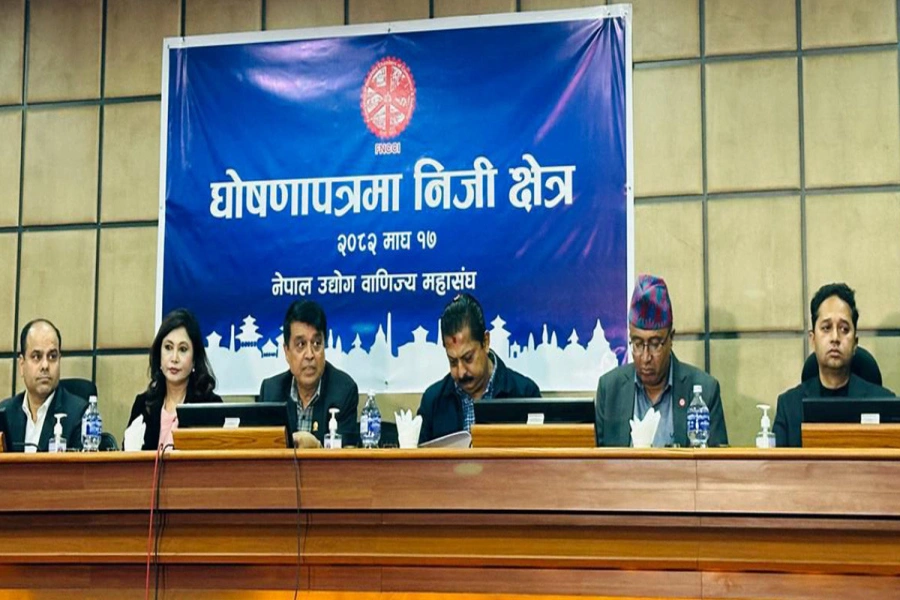
KATHMANDU, Feb 1: Federation of Nepalese Chambers of Commerce and Industry (FNCCI), an umbrella organisation of the private sector, has called on political parties to clearly enshrine private-sector protection, promotion and investment-friendly policies in their election manifestos ahead of the upcoming House of Representatives polls.
Addressing a press conference, FNCCI President Chandra Prasad Dhakal warned that the weakening morale of the private sector has made economic recovery and prosperity increasingly challenging. He stressed that restoring confidence among entrepreneurs is critical to reviving the national economy.
The FNCCI noted that the private sector contributes around 81 percent of Nepal’s economy and generates 86 percent of total employment, making its empowerment a core responsibility of the government and political leadership. It underscored the need for a policy environment that safeguards property rights, guarantees unhindered business operations and ensures long-term policy stability—commitments that should be explicitly reflected in party manifestos.
Referring to unrest on September 8 and 9, the FNCCI said the private sector suffered direct physical damage worth approximately Rs 36 billion, alongside economic losses estimated at nearly Rs 80 billion. While damaged structures have been rebuilt, the lack of assurance against future disruptions has left business confidence at a historic low.
Election Manifestos and Reformation of Government and Electoral...

The federation also expressed concern that despite adequate investable liquidity in banks, the private sector remains reluctant to borrow and expand. This, it warned, could shrink employment and government revenues and heighten the risk of capital flight if confidence is not restored.
Calling for liberal, innovation-driven and inclusive economic policies based on public–private partnership, FNCCI urged the amendment or repeal of laws and regulations that discourage entrepreneurship. It proposed fully digitising business processes—from registration and operation to exit by integrating services into the Nagarik App and scrapping the requirement for annual business renewals.
To strengthen business security, the FNCCI demanded the implementation of a “Private Sector Protection and Promotion Plan,” the declaration of industrial zones as special protection areas, the establishment of an industrial security mechanism, and fast-track, single-window services for rebuilding damaged infrastructure.
For the enhancement of the agriculture sector, it has recommended to launch an “Organic Hills Programme,” promoting cash crops, distributing farmer ID cards, and digitising subsidy distribution by linking it directly to production. It also proposed a “Farm-to-Gulf” initiative to facilitate exports of Nepali agricultural and food products to Gulf countries.
While tourism has been formally recognised as an industry, the FNCCI said implementation remains weak. It called for access roads, electricity and tax incentives for hill stations, hotels, teaching hospitals and polytechnic institutions, and urged the government to position Nepal as a hub for international conferences, conventions and destination weddings. Simplified visa and travel procedures for foreign tourists were also emphasised.
Among broader structural reforms, the FNCCI proposed declaring an “Investment Promotion Decade,” ensuring policy stability, and merging the Investment Board and the Department of Industry to create a powerful, unified investment promotion and protection authority.
To attract private investment in energy and infrastructure, it sought extended tax-holiday periods, priority for reservoir-based hydropower projects, and private-sector participation in transmission line construction. It also urged the government to prioritise the Nijgadh International Airport project, ensure effective operation of Gautam Buddha and Pokhara international airports, and remove legal hurdles to infrastructure development.
The federation further advocated expanded tax incentives for startups and the IT sector, the establishment of startup hubs, the launch of a “100 Startups–100 Investors” programme, and mandatory use of domestic software where feasible. It also called for respectful recognition of private-sector contributions in education and health, stronger collaboration, and improved coordination among federal, provincial and local governments.
On taxation, the FNCCI pressed for a simple, stable and competitive tax regime, including a multi-rate VAT system, tax cuts for productive industries, income-tax exemptions on reinvested profits, an umbrella law for non-tax revenues, and an integrated tax collection system.
The FNCCI concluded by stating that job creation, revenue growth and a prosperous Nepal are only possible if the private sector is secure, respected and motivated. It urged political parties to ensure that manifesto commitments translate into real implementation rather than remaining symbolic pledges. Detailed proposals have been shared with political parties, and the press conference was opened for media queries.
Senior Vice-President Anjan Shrestha, speaking at the event, noted that while there is frequent rhetoric about improving attitudes toward the private sector, tangible and consistent implementation is what truly matters.